
These posts are duplicated from LinkedIn, where they’re seen by tens of thousands of people each week. They often spark lively, valuable debate and your voice would be welcome. Visit my profile to connect with me.

This slide shows something most CX gurus don’t acknowledge — top satisfaction scores and market leadership seldom go together.
Volvo are no. 1 for CSAT and grew sales 27.6%. This is the kind of statistic CX pundits love.
Unfortunately, Ford are second to last in CSAT but sold 27 times more cars than Volvo. Mitsubishi came 23rd for CSAT yet grew sales by a similar amount to Volvo. WTF?
It’s because CSAT scores and sales % increases are meaningless without weighting for market share.
Volvo and Mitsubishi both have tiny market share and sales. Volvo’s 27% sales increase is only 11,312 cars. Ford however, sell close to 1.5m cars a year. Increasing sales by 27% is somewhat harder for them.
That’s not all. High market share means serving a broad customer base, and you can’t please everyone all of the time. Ford’s CSAT scores are lower because they’ve got more people to satisfy, not because they have a poor CX.
The implications are profound. If market leaders benchmark their CSAT against smaller rivals they throw money away trying to win an unwinnable contest.
More importantly, strategies that maximize CSAT and those that maximize market share aren’t the same!
Read this book to find enlightenment
See this post on LinkedIn
Lesson of the last two weeks: good things happen when you speak up!
Since I started voicing my concerns about the cranio-rectal interface that’s holding back the CX industry here’s what’s happened:
Engagement with our posts has been great and the reception has been overwhelmingly positive.
Followers are growing fast too, so it won’t be long before the voice of reason is the loudest.
Direct messages are coming in from people saying how refreshing our ideas are.
I’ve been invited to share our ideas on a growing number of webinars and podcasts.
More speaking bookings on CX and loyalty are coming in.
Other experts are sharing their ideas with me in a gesture of support.
I’ve been asked by a senior CX professional if I’ll act as a mentor.
More importantly, we’re creating a dialogue that the whole community can benefit from. In other words,
it’s working. It’s corny to say you need to be the change you want to see, but it feels like we're doing that. Thank you for your support!
See this post on LinkedIn

I’ve heard a lot of keynote presentations waiting for my turn on the stage over the years. Most of them go in one ear and out the other, especially when gurus start prattling on about the secrets of high performance teams. Blah blah blah.
I gotta say Richard Banfield’s session on high performance product teams at the Amex Summit was something else entirely: powerful, practical, entertaining, surprisingly emotional, and the best looking slides I’ve seen in years. His deck certainly put mine to shame! 🤦♂️
Check out his books and getting him in to speak if you’re looking for a true professional.
Your team will undoubtedly be better as a result of his advice. I know ours will be. Kudos. 👊
#keynote #products
See this post on LinkedIn
5 years of research
347,000 words of notes
1 master model behind business success
To cover the same amount of research as we put into The Grid, you’d need to read a book every three weeks for eleven years.
That’s why we’re called Methodical (and why we're not too keen on bullshitters!) 😆
#research #strategy
See this post on LinkedIn

A powerhouse brand like American Express can order a thousand copies of anyone’s book. They can invite anyone to give the keynote address at their annual product summits. They get to choose from all the speakers in the world.
When they choose you once it feels great. When they choose you to speak for a second time, it just makes you want to do an ever better job.
It’s a privilege to back with Amex here in sunny Phoenix. I can’t wait to get to the podium this afternoon. 🚀
See this post on LinkedIn
I am a big believer in customer experience.
Every day we interact with hundreds of products and services. Each of these interactions is an experience, and their cumulative impact on our quality of life can be tremendous.
I want everyone to have the highest quality of life they can (myself included) which is what drew me to this field in the first place.
As such, my criticisms of the industry come from a place of deep commitment and genuine love for my field. I want it to flourish. I want it to be credible.
The only way we can achieve those things in the long run is if we prove customer experience initiatives can be a win:win for customers and the organizations that fund them.
We desperately need to demonstrate that we can see the bigger strategic picture, and that we understand the contributions other disciplines make. We also need to prove returns for our work. If we don’t, customer experience will just be another corporate Roman candle.
My war on CX industry bullshit isn’t about putting people down, building a following, or being needlessly contrary. It’s about securing the long-term prospects of the industry I’ve devoted my whole adult life to.
Time to rest - big day tomorrow.
#customerexperience
See this post on LinkedIn
This is what falling at the first hurdle looks like:
“1. Set a common customer experience metric and target for the organization.”
Common sense dictates that:
Step one should be to understand the strategic objectives, opportunities and challenges facing your organization.
Step two should then be to figure out how customer experience initiatives might help the business address them.
Step three should be to identify the relevant metrics that demonstrate progress towards that goal.
Using a single metric to guide your decision-making will leave you fumbling in the dark when there are so many factors affecting business success.
Choosing this metric first, without considering the strategic imperatives governing the business means you could end up measuring the wrong thing!
If you want to know why so many CX programs fail to deliver a ROI, look no further!
#customerexperience #bullshit
See this post on LinkedIn
Except that:
Beats By Dre took 64% market share in just 4 years by building a powerhouse brand (arguably with quite a poor customer experience), becoming Apple’s largest ever acquisition.
Cylance, the fastest company to ever make $100m in revenue brought to market a fundamentally different and better cybersecurity product that used AI to detect threats more quickly. Not a “me too” product with a better CX.
SpaceX, who have secured over 100 missions worth over $12bn didn’t just take a regular rocket design to market and improve the customer experience, they made incredible technological leaps that are lowering the cost of space exploration.
Show me a business with a generic product and brand that have achieved the same staggering results as Beats, Cylance or SpaceX just by improving the customer experience and I’ll show you a squadron of flying pigs.
Grand pronouncements like these harm the entire CX industry by overpromising. They also make us look clueless and arrogant.
My one man war on bullshit continues! #customerexperience #bullshit
See this post on LinkedIn
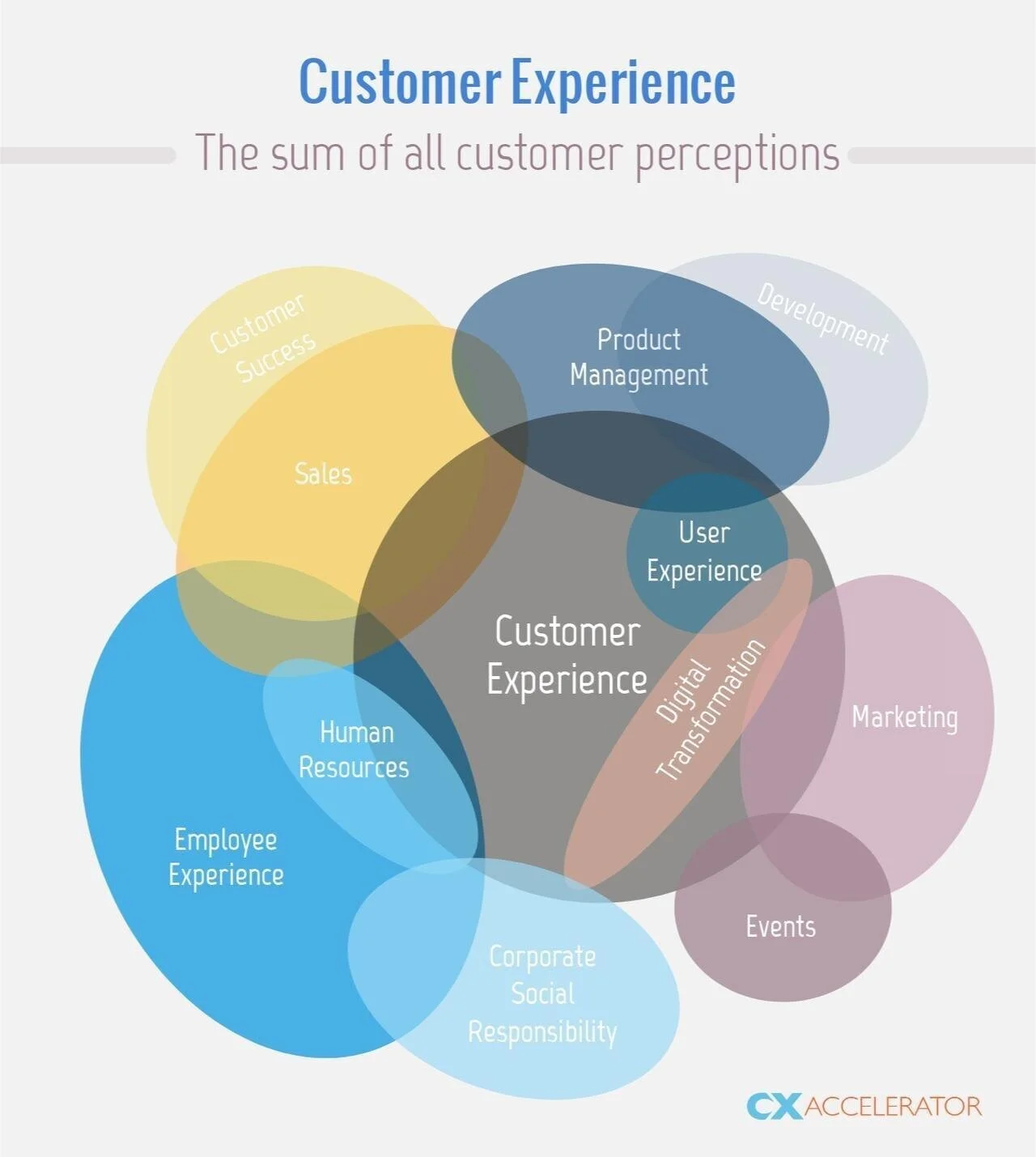
There are two easy ways to disguise flimsy thinking: jargon and complicated diagrams.
This one’s been getting likes and shares from the CX community, but a moment’s reflection reveals a multitude of sins.
The title and diagram don’t fit together:
If this is “The sum of all customer perceptions” where is branding, advertising and social sentiment / word of mouth? What are HR doing floating around in there?
Stupid labelling:
“Development” - Software? Nuclear weapons? Slide film?
“Events” - Customer interactions? Conferences? Morris dancing? Corporate Go-Karting?
“Marketing” - Does this encompass advertising, brand building, customer segmentation, pricing and everything else? Surely some of these warrant their own orbs if CSR get one.
Arbitrary overlaps:
Why does digital transformation sit entirely within customer experience, but “marketing” is just an appendage hanging off the side without any connection to product or sales? CX is really a subsection of marketing, not the other way around.
Misleading sizing and placement:
CX is huge and central. Marketing, product management and sales are small and peripheral, which is a gross misrepresentation of reality.
Net Bullshit Score = 11.
#customerexperience #bullshit
See this post on LinkedIn


Do the facts fit the theory? Here are some sacred cows in CX and some conflicting examples that are worth pondering:
Cow 1 - “We need to delight our customers.”
Amazon - often cited as the gold standard of customer experience - doesn’t delight their customers, they just provide a consistent, efficient service. This strongly suggests that effortlessness, not delight is the superior strategy.
Cow 2 - “Customer experience is now the main competitive battleground.”
And yet the media is awash with articles about how Apple - who excel at customer experience - are “in trouble” because their current line of products aren’t innovative or exciting enough. This strongly suggests that having a compelling product is at least as important if not more so than having a great customer experience.
Cow 3 - “Positive word of mouth is the most accurate measure of loyalty and growth.”
The service you probably use most on a daily basis is Google’s search engine. When was the last time you recommended it to someone? This strongly suggests that positive word of mouth actually declines the more we use something, which raises some interesting questions about NPS...
#customerexperience
See this post on LinkedIn
A lot is wrong with this article, but this little gem stands out:
“Research shows that customer acquisition costs 5 to 25 times more than retention … If you can hang on to customers by developing loyalty, you'll end up spending much less on marketing.”
Really?
1. The cost of acquiring customers is typically over stated because people think of advertising purely as an acquisition cost. That’s why the article says improving loyalty can save you money. Pure bullshit — advertising also reminds current customers that you exist. If you cut back ad spend retention suffers too.
2. Retention costs are typically under stated because people assume loyal customers buy more and are more profitable. In reality people buy what they need - If I become loyal to Whole Foods I don’t suddenly start buying more food than I can eat. Loyal customers often expect lower prices and better service as a reward, making them less profitable over time.
3. The cost of acquisition or retention is irrelevant - it’s the profitability of the customer that matters. Retain a loss-making customer at low cost and you’re still losing money. Acquire a high margin customer at comparatively high cost and your business is growing. Duh.
Do the sums, make an informed decision, don’t believe the bullshit.
See this post on LinkedIn

A couple of days ago I looked out of my hotel room window and had a small epiphany: I need to speak up more.
To date I’ve shied away from social media, but there’s a serious problem that needs to be addressed: the areas of business that I am expert in — customer experience, marketing and product strategy more broadly — are awash with bullshit that is going almost completely unchallenged.
While some of this advice is just stupid and harmless, a lot is downright dangerous. If followed, initiatives will fail, undermining the credibility of professions I care about.
I want to help people succeed. If I don’t provide an alternative viewpoint, I do everyone a disservice, myself included.
Who am I to judge? Good question! While I've got a lot to learn, I'm not without credibility: I wrote the only book on CX to win a major award. I’ve been invited to share my ideas with organizations from Microsoft to the FBI. I’ve met with thousands of leaders and professionals around the world. I’ve read almost 400 books on my field - one every two weeks for fifteen years. I’m also a senior visiting fellow at Cass, one of the top rated MBA programs in the UK.
If I keep that hard-won expertise to myself, what was the point in learning it in the first place? Time for a change.
See this post on LinkedIn
One thing many people in CX fail to understand is that a product or service can have experiential value without that being the domain of the CX team.
The comfort of a chair for example, or the interaction design of a software product - where ease of use is a fundamental component of the proposition, and rightfully belongs under the control of the product design team. UX in particular is a specialism in its own right.
This clear-headed explanation of the distinctions between CX and UX is helpful in resolving some of the confusion in this area. 👌
See this post on LinkedIn
More bullshit from the CX industry: satisfaction is "the key metric” for proving an ROI for customer experience, this article says. Unfortunately, to prove a return for your CX project from satisfaction scores you need to:
a) Prove it was your specific CX project that caused the change in customer satisfaction — not changes elsewhere in the business like price promotions, product improvements or advertising — which in reality is almost impossible.
b) Also prove that this change in satisfaction had a clear financial payoff which is all but impossible too, because satisfaction, revenues and profitability can change independently of one another. If we cut back on advertising, for example, satisfaction can increase and revenues decline because people forget we exist. If switching costs are high, revenues can stay buoyant even if satisfaction declines.
In summary then, try to prove ROI from satisfaction scores and you may find:
Satisfaction increases but you can’t prove it was your work.
Satisfaction doesn’t increase at all because of changes made outside of the CX initiative.
Satisfaction improves but financial performance doesn't.
It's no wonder leaders are skeptical.
See this post on LinkedIn
If you work in CX and you haven't read Matt Dixon's book "The Effortless Experience" you are borderline negligent. It's everything a business book should be: provocative, well researched, pragmatic, and totally absent of management film-flam.
I highly recommend keeping up with his continued research in this area - his blog is great place to start.
See this post on LinkedIn

#Airbus have announced that they will stop making the A380.
This is an extract from p. 73 of The Grid book where we point out that very few people thoroughly consider adoption barriers when creating new products and suffer the consequences. Helpfully, the book also shows you how to avoid this problem altogether!
The sooner people start using The Grid to make decisions the better 😝 methodical.io
#adoptionbarriers #strategy #productdevelopment
See this post on LinkedIn
Blog posts like the attached perfectly demonstrate a major problem in the CX industry - bullshit statistics that don't stand a moment's scrutiny. 4 of the first 5 are complete nonsense:
1. By 2020 customer experience will overtake price and product as the main differentiator between competitors.
Check the report and you'll see the claim is based on the opinion of a small number of guess who? CX professionals - biased.
2. $1billion company can generate an average $823 million revenue increase in three years with only a moderate enhancement in customer experience.
A $1bn company at what stage of market maturity? Unprovable.
3. Increase customer retention rates by just 5% and profit increases anywhere from 25% to 95%.
Already been debunked in the book Loyalty Myths. Profit potential from increased retention varies dramatically based on your current retention rate: If you already retain 95% of your customers getting an extra 5% (to 100%) is likely to seriously reduce your profitability! Retaining customers who are unprofitable in the first place will only lose you money.
5. Companies which deploy a thoughtfully crafted customer service program enjoy a 92% customer retention rate.
A very specific statistic for a very vague claim!
#customerexperience #bullshit
Get VOIP “The 75 Customer Service Statistics You Need to Know in 2019 and Beyond”
See this post on LinkedIn

Looking forward to speaking with MBA students at the University of Auckland this morning! I’ll be debunking some of the bullshit myths in the CX industry, in particular:
That customer experience is the most powerful source of competitive advantage when it’s probably the weakest.
That most brands can “win” on customer experience when in fact, most can only not lose.
That NPS and CSAT measure customer experience when they don’t.
That delighting customers is a smart strategy, when it’s usually commercial suicide.
That satisfaction creates loyal customers, when it doesn’t...
Ought to be enough to set up a lively Q&A. 🤣 See for yourself on LinkedIn