
These posts are duplicated from LinkedIn, where they’re seen by tens of thousands of people each week. They often spark lively, valuable debate and your voice would be welcome. Visit my profile to connect with me.
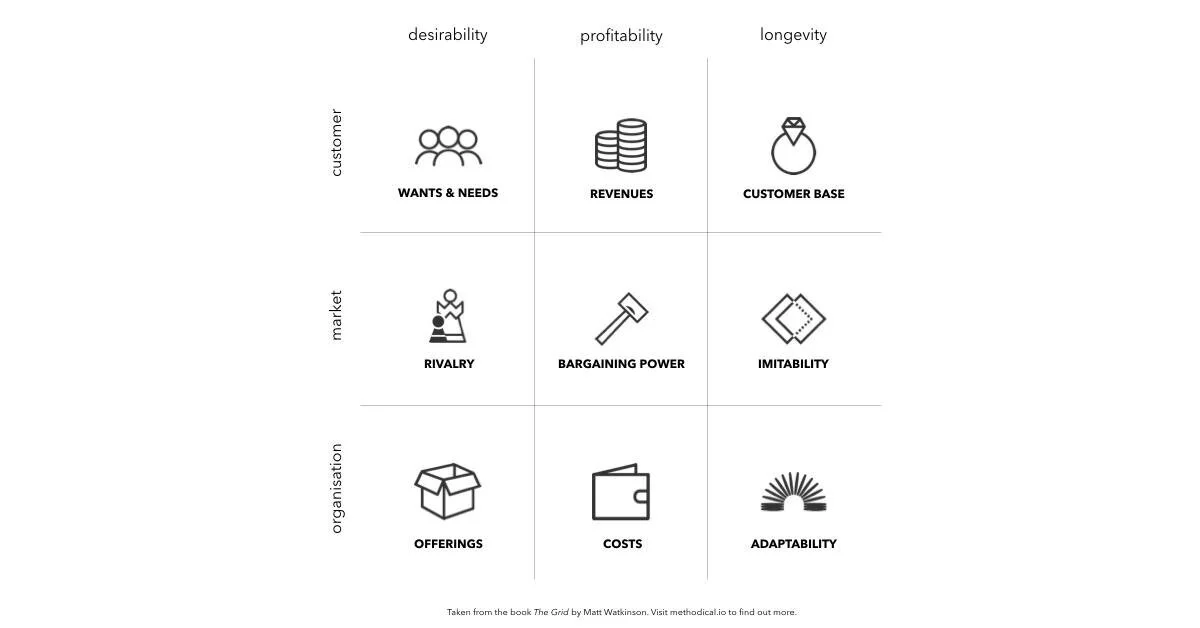
I recently opined that no business should be customer centric. This diagram explains why.
To survive, any business must balance three interrelated objectives: desirability, profitability and longevity (the columns).
They must also consider three contextual factors: their customers, market and organization (the rows).
Since any factor can influence any goal, we get a grid of nine elements that together determine our business success. Also, since a business is an interconnected whole, changing one will affect others — cutting costs can harm adaptability for example.
Basic conclusions:
All nine boxes matter — any is potent enough to cause failure if mismanaged.
Only three directly relate to the customer — wants and needs, revenues, and the size and commitment of our customer base. If more powerful rivals can easily copy us or we run out of cash we're in trouble, however customer-focused we are.
Fixating on customer wants and needs, believing that the other boxes will take care of themselves is a dangerous fantasy.
More simply: success always comes from making astute trade-offs that balance these nine elements.
When CX teams start framing projects in terms of their impact across these nine elements, THAT's when they'll get amazing results...
See this post on LinkedIn
It's widely believed that we should start with the customer's wants and needs when developing new products or improving experiences. This won’t do you any harm, but it overlooks a powerful insight: our sense of identity — of who we are or want to be — not only precedes our goals, but directs them.
There's a couple of basic reasons for this:
First, we’re predisposed to economy of thought. Assuming an identity then simply acting in accordance with the norms for that persona unburdens us from the tyranny of choice. Our identity is a shortcut for basic decision-making.
Second, we’re a highly social species. If we acted without considering our identities — as members of groups and communities — we'd violate social norms and risk being ostracized. Our identities allow us to navigate complex social environments.
By implication then, we must first understand who our customers are and aspire to be, then strive to create products, services and experiences that reflect and reinforce that identity, through any means possible — community-building, enhancing status, etc.
"Sign value", as the philosopher Jean Baudrillard called it, often holds greater appeal than "Use value" — as brands like Beats By Dre (who gained 60% market share in 3 short years) have demonstrated.
See this post on LinkedIn
It's about a year since I came out of cryosleep and started posting here. I had three simple aims: expand my network of experts across disciplines that interest me; share what I’ve learned in the hope that it creates value and provokes meaningful discussion; and gently remind the world of my existence.
My approach has been pretty basic: one or two posts a week on topics I’m vaguely qualified to opine on — design, customer experience, product strategy, writing, reading and speaking. I’ve also focused on writing the kind of stuff I enjoy reading: simple, pragmatic guidance for the most part — rather than saccharine goop, or vacuous self-promotion. (All in good time...)
How's it gone?
Well, the response to the content has been great. There's been plenty of valuable dialogue that I for one have learned a great deal from. But the real win has been the quality of the connections. I’ve made meaningful friendships, met plenty of amazing people in person, and chatted about a bizarre range of topics in private, beyond the obvious work stuff — from vintage BMX restoration to classical music recommendations.
Thank you to all who have connected, commented, challenged, critiqued, conversed and co-conspired. Here's to the next twelve months!
See this post on LinkedIn
The single idea that’s had the most impact on me is the Buddhist philosophy of turning poison into medicine.
In effect, that adverse events contain the potential for positive outcomes; that failure is often the springboard to success; or that frustration with the status quo stimulates change for the better.
I find it so compelling because I’ve yet to find a situation where it isn’t beneficial.
In the workplace, for example, those who solve problems rather than whinging about them progress faster and are more fun to be around. It’s also the essence of entrepreneurship — seeing crappy products or services as opportunities to create something better.
Outside of work, if we re-frame struggles as opportunities: to develop our character, learn valuable lessons for the future, or prevent others from experiencing a similar fate, then positive, fulfilling outcomes are possible even in dire situations.
It's also the underlying mindset that drives successful designers, and customer experience professionals more broadly. The aspiration is always to improve people’s quality of life — to take what is stressful, tedious or unpleasant and remove or improve it.
Turn poison into medicine... A simple philosophy perhaps, but I’ve yet to find a more effective one.
See this post on LinkedIn
Speaking at events is usually a pretty lonely experience. You may be the focus of everyone’s attention for a turn, but the rest of the time you’re in a hotel, airport or on a plane by yourself.
I recently realized that it doesn't have to be this way though, so decided to do things differently on this trip.
Over the last year I’ve connected with some really insightful marketing and CX people in Melbourne, so I asked a handful of them if they'd like to get together. Not only did they say yes, they showed up and didn’t leave until late o'clock. Most of them were meeting for the first time too.
A couple of reflections:
When it comes to LinkedIn you really get out what you put in. Focus on creating value for other people and they'll reciprocate. As your network grows you can bring others together too, and again, they'll reciprocate. Everyone benefits.
Second, we do a lot of silly stuff on autopilot that's absurdly easy to change. From now on I'm going to try and meet new people in every city I visit.
Huge thanks to Ben M., Everard Hunder, Lisa D'Amico, Saiful (Sai) Nasir, Kerry-Ann Benton, Ebenezer Banful, Michel Hogan, Zora Artis, GAICD SCMP and Michelle Marlan for the awesome night out. Also to Meqa Smith who I met in Brisbane. You're amazing. Thank you!
See this post on LinkedIn
I remember learning the law of energy conservation at school — the total energy in a system remains constant, it’s just transferred from one place to another. Well, the same is true when there's a customer and service provider.
If some writing is easy to read, for example, it’s not because it tumbled out onto the keyboard that way. It's because the author slaved over every word — hence Blaise Pascal’s witty remark, “If I had more time, I would have written a shorter letter.”
When user interfaces have an intuitive obviousness to them, you can bet they didn't start life that way. Rather, those creating them had the discipline, diligence and bloodymindedness to keep refining them.
It’s also true in the broader realm of CX. When processes can be completed quickly, easily and reliably; when there are thoughtful details that convey care and attention; it’s because there was care and attention.
Achieving effortlessness demands great effort from the provider — there's no way around it. So what should we do?
Start earlier. Narrow the scope. Approach the task systematically, and keep going. Ask yourself: "Is it as easy as it can be? If not, why not?"
When you're satisfied — having spent all that effort — you can bet your customers will appreciate spending none.
See this post on LinkedIn
I can't tell you how many journey maps I’ve seen and mapping tools I’ve tried, but I can tell you most of them miss four things that are immensely valuable:
Wait times
Explicitly calling out wait times — where they occur and for how long — is important, since managing them reduces the perception of effort and unnecessary stress caused by uncertainty.
Existing expectations
Few journey maps include a swim lane for expectations, even though everyone agrees that they play a pivotal role in determining our satisfaction. Asking “What is your customer expecting to happen at this point?” also forces us to visualize the journey from the customer’s perspective. Often the answer is, “We’re not sure.” A valuable insight in itself.
Expectations to set
Actively considering the expectations you should set with the customer at each stage makes a huge difference too. Often they'll only have a vague idea what to expect, so telling them gives you more control over their satisfaction. It's also cheaper than improving the service.
Errors
Listing the mistakes people could make at each point in the journey is an eye-opening exercise that's loaded with value, since error prevention reduces customer effort and stress while also lowering cost-to-serve — a 3-for-1 deal not to be passed up!
See this post on LinkedIn
The likelihood that you are disrupting someone or they are disrupting you — in any meaningful sense of the word — is about the same as being struck by lightning. The logic is easy to follow:
For a disruption to occur there must be a disruptor and disruptee.
Their products or services must be viable alternatives to one another.
The disruptor must be growing its customer base at the expense of the disruptee.
It must be beyond the adaptive capacity of the disruptee to respond to the new entrant with a more compelling offering.
It must also be impossible for the disruptee to copy the disruptor’s proposition or simply acquire them.
If these conditions aren’t met it’s just good, old-fashioned competition, but why does it matter?
Because the prospect of disruption turns people’s brains to jelly. Incumbents swap clear-headed analysis for outright panic or endless hand-wringing. And start-ups — drunk on the prospect of dominating the market — fixate on scaling and forego the basics, like sound unit economics, cost control or even obeying the law.
Next time you hear the D word, ask yourself — "Do they actually just mean competition?" And calibrate your response accordingly.
See this post on LinkedIn
Let’s zoom out for a minute.
I’ve spent the last couple of months working on a client project to improve the diagnosis and treatment experience for people suffering from a common and often devastating medical condition. (Cryptic I know, but I’ve signed my life away.)
Hearing patients' stories was the first time I’ve shed a tear at my desk that wasn’t from stubbing my toe on the table leg. It also provided a timely reminder.
I was drawn to work in design and customer experience because I fundamentally believe that these disciplines have the potential to improve people’s quality of life. Sometimes in little ways too subtle to notice, sometimes in big ways that leave an indelible impression, but the potential is always there.
We may get bogged down in the corporate quagmire. We may bicker about methods, metrics and management. But let’s not forget why it’s worth it: our work can and does make a positive contribution to people’s lives and society at large.
On this, at least, we can all agree.
See this post on LinkedIn
Every author faces a stark choice: do I discover my book’s shortcomings before publication and correct them, or from reader reviews when it’s too late?
If asked, few would propose the latter — whether launching a book or any other new product — yet it’s remarkably common because many people have never learned this vital life lesson: there’s a difference between someone criticizing your work and them criticizing you.
If each time someone points out a flaw, blemish or weakness in our work we take it personally; valuable opportunities to improve are misconstrued as assaults on our character that we’d rather avoid. Unable to separate our ego from our output, we dodge or deflect critical feedback.
Unfortunately though, the quality of any product or service is not so much determined by the brilliance of the creators, but by the quality of the criticism and scrutiny it’s subjected to. So if you truly want to succeed you must jump into the fire. Seek out prospective customers and experts who are hard to please and can view your work objectively. Gather their raw feedback. Learn to thrive on well-intentioned criticism.
It may hurt at first — your ego will bruise like a peach — but the pain soon becomes a pleasure when you realize just how much better the end result is.
See this post on LinkedIn
Many consultancies and agencies get started by winning a single big client. They work hard to keep that client satisfied and keep them spending, often with great success.
You can build a seven-figure business this way with a good tailwind, and it's exactly the advice most people would give you: focus on your key client, turn them into fans and increase their spending. With no nasty acquisition costs you'll print money!
It sounds like it all makes sense, except that it doesn't (quite). The problem is that it completely ignores concentration.
With most of your revenue coming from one (or maybe two) clients, it only takes a small change beyond your control — a strategic re-think, budget cut, or supplier consolidation — and you could take a massive revenue hit, need to lay off staff, or lose the whole business. I've seen it happen too often.
For any small business lucky enough to win a big account, acquiring more clients is a priority. The goal is not to milk your biggest customer dry — it's to ensure you can survive without them.
Having ten clients paying $100K each is much less risky than one paying $800k and four paying $50k each.
Yes, you may be less profitable in the short-term this way. But long-term, well, you might actually have a long-term.
See this post on LinkedIn
We all have blindspots, and a common one for the CX community is not applying the principles of our craft when producing content. Nobody benefits: low engagement is frustrating and useful lessons go unlearned.
Some fundamentals to consider:
Have a clear audience in mind.
Always write for the reader. Self-indulgent writing belongs in a journal.
Create value for them, not you.
Focus more on your audience's challenges or opportunities, and less on self-promotion, selling, ranting, et cetera.
Consider the outcome.
What should they do next — engage in a debate, do something differently? The clearer and more practical the outcome, the better.
Make it effortless.
Unless your content is grade A+ avoid using video or long-form articles — it's too hard to hold people's attention. Short, jargon-free posts are easier all round.
Entertain.
The odd analogy, humorous remark or turn of phrase is usually enough to bring some levity.
Be distinctive and memorable.
If people don’t notice or remember your message it is ineffective.
Do less, better.
One great post beats ten average ones.
In summary: picture someone checking their phone in line at the supermarket. Your mission — create something valuable they can enjoy before they get to the cashier.
See this post on LinkedIn
If you're discussing a potential project with a prospect or client — whether you’re a freelancer, consultant, small business owner, or anything else — asking these two simple questions can improve your chances of winning the work and delivering it to their satisfaction.
Question 1 — What matters most to them about the project?
Question 2 — What matters most to them about who they partner with?
(Adapt the language to suit the situation.)
Whenever I've asked these questions, the answers haven't been what I’ve expected and the insights have been invaluable.
p.s. Read “Gap Selling” by Keenan.
See this post on LinkedIn
Your goals, and the sophistication of your approach to achieving them, should reflect your current abilities.
If you’re a novice runner, for example, you need a pair of well-fitting shoes, a stopwatch and a simple training / stretching plan. You can post some impressive times with nothing more if you work hard.
If you’re getting pretty quick and aren't picking up injuries, you might start looking at a more sophisticated training and diet regime and using a heart rate monitor to optimize your training.
Then, when it's time to go from good to great you can worry about shaving off the last few percent of body fat, recovery massages, nutrient timing, 3d form analysis, etc.
This probably sounds obvious, but when established businesses build a new competency, they rarely say, "We're beginners. Let's try something basic." They act like they're already Olympians because they have Olympic-sized resources. The result is often frustrating failure and a huge waste of time and money.
If you’re starting a CX program, keeping it simple can help you gain traction. Deliver basic improvements, then gradually get more ambitious. Start, experiment, learn, and grow. If things aren't working, simplify.
Don't attempt a moon landing before you can run, and never mix your metaphors.
See this post on LinkedIn
The growing talk among the CX community about employee experience is making me uneasy.
I can see the link between happy employees and happy customers — for service staff especially. And the concept of an internal customer makes sense if you’re providing a service within an organization.
That said, what does employee experience actually mean in practice?
Surely the dynamic between a customer and a brand isn't the same as between an employee and employer? How much of what we know is relevant?
Even more variables determine an employee's experience than a customer's. With their boss, salary, team dynamics, workload, office politics, culture, etc. all playing a role, will we scope creep our way into oblivion?
How do we know what the impact is, or if we’ve improved an employee's experience? I see that ENPS is already a thing...
Are CX pros qualified to opine on the topic? What do we know about HR, operations management, leadership, team building, hiring policy, incentive structures, etc.? I, for one, know nothing.
Finally, is the new-found fixation on the link between employee experience and customer experience just a convenient change of tack to explain lackluster results for existing programs?
Educate me — I'm open-minded!
See this post on LinkedIn
There seem to be four broad schools of thought when it comes to customer experience:
1. CX as everything
Since anything can affect your perception of an experience, CX is all-encompassing — including pricing, brand, product, advertising, service, etc. While arguably correct in an abstract sort of a way, this philosophy ignores existing specialisms and can lead to futile over-reaching.
2. CX as connective tissue
Everyone works in a silo, so CX teams should act longitudinally to join things up and plug gaps. This is more pragmatic, but requires cooperation and cat-herding. Proving value as a link is often harder than as a node.
3. CX as a cultural disposition
Good CX is an attitude. You don’t need a CX team because everyone is your CX team. You get it or you don’t — it’s in the DNA or isn’t. This might be true, but it doesn't help those who want to improve.
4. CX as a means to an end
We identify a business goal — improve conversion, reduce returns, etc. — and ask ourselves “How might we use our skillset (customer research, journey mapping, interaction design, etc.) to help achieve it?” The most commercially astute approach, but runs contrary to common practices.
They aren't mutually exclusive of course, and each has pros and cons...what do you lot have to say?
See this post on LinkedIn
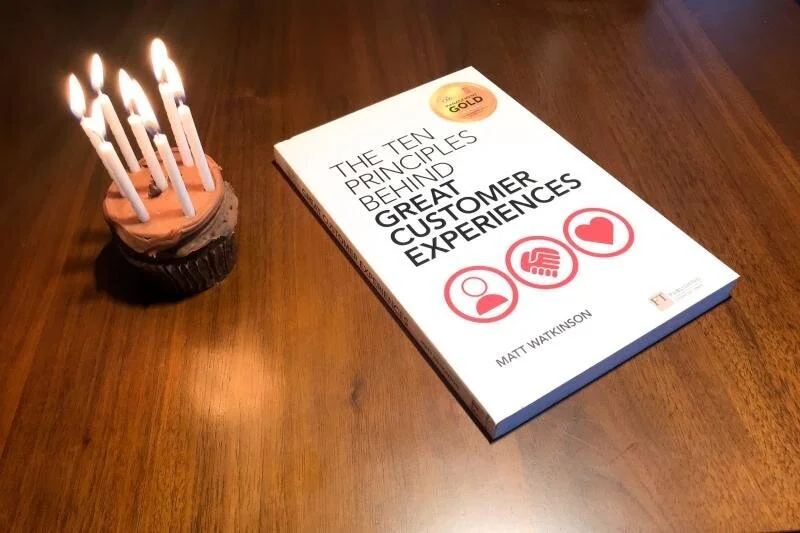
I spent my formative years at a British boarding school — a bit like Hogwarts without the magic, where everyone was in Slytherin.
Like any institution there were codes of conduct. One of them — reinforced at home — was that it’s indecorous to boast of your achievements, and shameless self-promotion is particularly undignified, which is why I’ve never gone in for either.
That said, this month is the 7th anniversary of my first book's UK publication — The Ten Principles Behind Great Customer Experiences — so here's some facts about it that a less encumbered individual might mention:
In the UK (and elsewhere) it's still among the best-selling and highest rated books on the topic. Some businesses have ordered a thousand copies at a time.
It is Amazon UK’s top search result for customer experience. It also remains the only book on the topic to win a major UK book award (to my knowledge).
As you might expect from a 28 year-old, first-time author it isn’t perfect though. There’s room for pruning and I got some stuff wrong — most of which I atoned for with The Grid. A second edition is probably overdue. That said, the actual principles hold up remarkably well and work beautifully in practice.
To everyone who's bought, read or recommended it — a heartfelt thank you!
See this post on LinkedIn
I started writing here last year because it was clear to me that the CX industry was heading to a bad place.
Too many commentators were creating too much hype and suggesting strategies that simply couldn’t work. Some were bad-mouthing other disciplines.
Over-promise, under-deliver and alienate yourself in the process? That’s a disaster in the making.
As a somewhat lonely voice I’ve tried to provide a counterpoint — critiquing the hype and bad research, explaining the value of adjacent disciplines, the flaws in various metrics and strategies, while presenting pragmatic alternatives.
In the process I’ve gained some support, but has anyone changed their tune? Not really. There’s even more hype. Plenty have just blocked me from seeing their content rather than face a well-reasoned critique. Some just shrug and carry on with business as usual.
Well, it's coming home to roost. Many programs continue to deliver no tangible value. Now Forrester’s top prediction for 2020 is that 25% of CX pros will lose their jobs.
This year please do more to question the hype and dogma. Abandon the loyalty myths. Ship more real-world improvements. Do more to directly support top-line growth and customer acquisition.
I'm trying to help us all succeed. Don't make me beg, ok? :)
See this post on LinkedIn
Some prominent CX advocates and authors claim that customer experience is *the only* sustainable source of competitive advantage. But is it true?
A competitive advantage is a benefit that allows a business to outperform rivals. There are two tests:
1. Superior profitability to your strongest competitor (you can’t claim superior performance otherwise).
2. Stable or growing relative market share (its also hard to claim advantage if you’re losing customers).
Examine the businesses that pass these tests and you'll see their advantages typically stem from these 6 things:
Chain-linked activities where an entire, complex value chain must be copied.
Unmatchable economies of scale or low costs.
Customer lock in through high switching costs, reduced interoperability or ecosystems.
Physical location (a hotel maybe).
Government protection (state monopoly or IP law).
Network effects (locking customers in and rivals out).
In reality then, customer experience — while important — is quite unlikely to be a genuine source of competitive advantage full stop, and to boast that it's the only one is absurd.
Why does it matter? Because these kinds of bogus, hyperbolic claims harm our industry in the long run, leading people to make impossible promises that can't be kept.
See this post on LinkedIn
Are there any practical downsides to just assuming that brand loyalty doesn’t exist?
We could stop being distracted by shiny new objects from dubious loyalty gurus.
We could drop expensive quests to create super-fans who may well jump in a bin fire for our brand, but seldom contribute much to our overall revenue.
We wouldn’t delude ourselves into thinking people have an “emotional connection” to our business only to be shocked if they stop buying.
We could abandon a trove of questionable metrics and the statistical contortions needed to prove their links to growth.
We’d also avoid launching profit-sapping loyalty schemes.
Instead, we’d develop a heathy paranoia that customers might leave, and with that:
a) Work harder to acquire new customers, helping our business grow
b) Constantly find new ways to create more value for customers, giving them tangible reasons to keep buying
c) Assume we're only as good as our last job and provide consistently better service
d) Focus more on structural opportunities to retain customers — like building ecosystems, etc.
Best of all, if people did turn out to show us some kind of loyalty, we'd get a positive surprise, rather than yet more disappointment caused by too much hype and too few results!
See this post on LinkedIn