
These posts are duplicated from LinkedIn, where they’re seen by tens of thousands of people each week. They often spark lively, valuable debate and your voice would be welcome. Visit my profile to connect with me.

I have good news. At long last, our new book has a title.
Mastering Uncertainty: How great founders, entrepreneurs and business leaders thrive in an unpredictable world
Now that it's been typeset, reading it in the flesh — if that’s an expression — it’s clear that the time we’ve spent polishing the manuscript has been well worth it. There is no fat, fluff, filler or flim-flam to be seen, and only a handful of minor corrections have emerged from the proofreading.
It’s also clear what an immense privilege it has been to collaborate with an investor and entrepreneur of Csaba Konkoly's calibre and experience. I’ve learned a humbling amount from partnering with him on this project, and I’ve little doubt that the readership will too when the book is released in July.
Thanks for all the support so far. Hope you’re all doing well. Feels good to be back.
See this post on LinkedIn
In my last guest post for Stella Connect I ponder a couple of annoying questions:
Why is it that people can instinctively do things that make a friend, partner, or even a total stranger feel special or welcome in their personal lives, yet in a professional capacity those same people often cannot do the same for customers?
And why is it that many small businesses are capable of providing exceptional service, yet many large companies with far greater resources at their disposal find this impossible?
The short answer:
As a business scales or an individual switches from a personal to professional context, three things are often lost that are essential to creating exceptional customer experiences: psychological proximity, autonomy, and skin in the game.
Thanks to Hannah McCabe for the opportunity to share my ruminations. It's been fun.
#customerexperience #cx
See this post on LinkedIn
How to succeed at school:
- Do as you’re told
- Follow the rules
- Fit in
- Avoid failure
- Absorb and regurgitate academic knowledge
- Provide a single correct answer
- Improve your weaknesses
- Perform well on individual assignments
How to succeed in business:
- Question established ways of doing things
- Change the rules
- Stand out
- Risk failure to win bigger
- Try stuff out and see what happens
- Consider multiple possibilities and perspectives
- Capitalize on your strengths
- Work as a team
See the problem?
See this post on LinkedIn
Once you’ve grasped the rudiments of a field, reading discipline-specific books quickly reaches diminishing returns.
I’ve only read one book on customer experience in the last ten years, for example. Not because I think I know it all, but because I want to bring something new to the discipline, stretch my mind in different directions, and expose myself to leftfield ideas, which generally means avoiding the established canon. What I’m trying to do with my reading is create my own little intellectual Galapagos where new ideas can take shape away from the mainland.
I can’t recall reading a single CX book as reference material when I wrote my own book on the topic. Instead, three of the key reference texts were The Lonely Crowd (anthropology), Baudrillard’s System of Objects (philosophy) and The Complete Stanislavsky ToolKit (method acting). Similarly, the whole idea for The Grid was inspired by a physiotherapy textbook called Anatomy Trains.
If you want to innovate or make a meaningful contribution to a field, rather than binging on category bestsellers I’d encourage you to read more broadly, immersing yourself in whatever piques your curiosity — knitting, comedy, Victorian plumbing, astrophysics, whatever — then allow everything to marinade in your mind.
Soon enough new ideas will bubble to the surface, and then you’ve got something fresh and exciting to contribute. Best of all, one good idea is often all you need to change the trajectory of your career for the better, stand out from the crowd, and push your discipline forward.
See this post on LinkedIn
Update on the book — I see a light at the end of the tunnel.
Since submitting the initial draft of the manuscript we’ve completed three out of four rounds of editing.
The first round was mostly structural changes within chapters to improve readability and flow. Seven of eight chapters had their contents repackaged, and three had new introductions written to frame the concepts better.
The second round scrutinized the content more, smoothing awkward language, fixing inconsistent usage of “we” vs. “you”, correcting the occasional muddled tense and weeding out a few of overused expressions (I used “as such” twelve times in the first draft, now it has been eliminated entirely).
The third round was a final critique of some word choices, for example replacing the term “farting around” with “experimenting” in one memorable paragraph. There were only forty or so comments in the margin by this point — a pleasant change from the sea of red ink in earlier versions.
Upcoming round four is copy editing — checking for typos, etc. — which thankfully is not my job; final legal / fact checking — also not my job; and double checking all the citations are correct and well formatted — also not my job!
We’ll give it a final read over after this round, and from there the book will be typeset and, well, look like a book for the first time.
Still no definitive title and subtitle although there are some great contenders. Booky McBookface is not one of them — sorry!
See this post on LinkedIn
What you’re trying to do has probably been done before. And even if you’re genuinely breaking new ground, you’re probably combining existing skills or technologies in a new way.
This is great news, because it means that in the vast majority of situations there is a simple formula for success:
1. Find an expert
2. Ask them what to do
3. Do it
For whatever reason though, most people struggle with this. They either find an idiot and ask them what to do, find an expert and tell them what to do, or find an expert, ask them what to do, then do something else.
I don’t really get it. For me there’s something blissful about taking good advice and getting the results I want with the least effort possible. Life is just sooooo much easier when you’re coachable.
Follow my ingenious three step plan and you can’t go far wrong.
See this post on LinkedIn

Well, it wasn't really part of the plan, but this is the first interview where I've spilled the beans about the new book. Judging by Sophie's reaction to the ideas, themes, and examples, I think you'll want to have a listen...
Here's the link to the recording: https://lnkd.in/gZ_XjHWh
Enjoy!
See this post on LinkedIn
My team and I have done a fair amount of work in life sciences / medtech / pharma / healthcare prior to and since Methodical was formed, so when Exeevo came along and asked me to spill the beans about CX strategy for life sciences I was all over it.
We've done a neat adaptation of our "The Leader's Guide To Customer Experience" paper and presentation together specifically for this audience, so if you're in this space and want to set your CX initiatives up for success, please join us!
See this post on LinkedIn

If you’ve read and enjoyed The Grid, you have this gentleman to thank.
He's the publishing director at Penguin Random House, bought the world rights for both The Grid and forthcoming book three, and has edited both of them — client, partner and (tor)mentor all rolled into one, then.
We met last week and there is good news. The Grid has been a nicely profitable enterprise for the publishers and foreign language deals are still coming in. The book will be available in Japanese shortly, alongside Russian, Ukrainian, Portuguese, Spanish, Chinese and some others I’ve forgotten, which have been out for a while.
After the first round of editing / bloodbath for book three he is now broadly happy with the shape of the book and the structure and framing of each chapter, which means we now move onto round two: finer grain copy editing and refinements. Once we’re done there we’ll move into more technical editing: triple checking citations and references, and resolving any typographic snags. After that they’ll start laying it out as an actual book.
The big issues still to resolve are areas where I struggle most: title, subtitle and general market positioning. Fortunately we have an excellent team to help with this, and already have some great thought starters...we’ll get there soon enough. I’m not asking you lot for help incase I end up with a “Booky McBookface” situation.
Let the good times roll.
See this post on LinkedIn

'Twas an absolute pleasure to be interviewed by CBRE for their podcast. They asked a broad gamut of challenging questions spanning not just the subjects of books one and two — customer experience and systems thinking slash strategy respectively — but also strayed into the territory of forthcoming book three: making decisions in an unpredictable world. I hope you enjoy our lively dialogue.
#customerexperience #cx #strategy
See this post on LinkedIn
Picture the scene...you get your sports bike back from the garage and take it out for a spirited ride in the canyons. With a corner fast approaching, you brake, pull in the clutch to change down a gear, and press the shift lever with your foot, only to find yourself pressing on thin air. The mechanic has failed to attach the gear lever correctly, and vibration from the engine has caused it to come off.
This was the exciting situation I found myself in last week, which understandably prompted a call to the garage’s customer services department.
How did they handle this potentially fatal mishap? Badly enough to make it the focus of this guest blog post, which concludes with a simple yet often overlooked truism:
Whoever handles a customer call represents your entire company. They are not just providing customer service. They are expressing your culture, exhibiting your brand, directly or indirectly selling your products and services, performing vital customer and market research, executing your loyalty program, and building and managing relationships for the future.
Customer service isn’t just customer service in other words. It can make or break every other marketing effort in the company — a sobering realization that no business should lose sight of.
Ps. Kudos to Stella Connect for leaving in the line about my twitching colon.
#customerexperience #cx #customerservice #contactcenter
See this post on LinkedIn
Want to create the maximum value possible for your customer and business from your customer experience initiatives? Of course you do, and the key is something nobody is writing about: prioritization.
You’ve got limited means and you’re in a race against time. You can’t do everything so how do you decide where to focus? Here’s how we do it:
Level 1: The business goal
Pretty simple: Start by understanding the commercial challenges and opportunities you are facing and make sure any initiative directly supports them.
Level 2: The customer
Different customers have different needs, and not all customers are of equal importance. Yes we love them all but we love some more than others — those who can most readily help us achieve our business goals, typically. (See level one).
Level 3: The scenario
Customers find themselves in a variety of scenarios. These can be prioritized by “stake” — how important they are to the customer, frequency of occurrence, or volume of customers affected — or some combination. Once we know the scenarios we can model how these play out as customer journeys.
Level 4: The journey stage or interaction
Not all interactions or pain points along a customer journey are equally important because not all of them affect the customer’s perception of the experience equally. Fixing bad is more important than making good better, for example, and the peak-end rule comes into play when it comes to memorability.
Level 5: Cost:benefit of implementation
Once we’ve got all our potential opportunities in a backlog we prioritize them based on their cost benefit (desirability, penalty, cost, effort, whatever) and double check them against levels 1–4 to make sure we’ve kept on track.
Work through these five levels and you’ll make improvements that change the customer’s perception of value and meaningfully contribute to your business performance. Do it another way and, well...I don’t know what will happen, because we don’t do it that way.
#customerexperience #cxstrategy #cx
See this post on LinkedIn
How can we improve our performance at a given discipline? These are the basic options:
Better technology, equipment and tools.
Better processes and techniques.
Better insight and understanding.
Better mindset and attitude.
How would you rank their impact?
Technology is great, but as soon as someone has better technique they will wield the same tools more powerfully. Lewis Hamilton would be quicker around Silverstone than me in a Trabant for example. Plus most technologies are available to anyone with the money.
Better processes and techniques are advantageous then. But we can easily imitate or follow a method without knowing how or why it works. I can wire an alternator by following the instructions, but if I get it wrong I’ve no idea how to put it right, or whether there might be a better way. As Emerson remarked, “'The (wo)man who knows how will always have a job. The (wo)man who knows why will always be their boss.”
Insight and understanding is better still then. They allow us to stop imitating and start innovating from base principles. The problem is that facts have a half life and our theories might turn out to be wrong or have limited scope. If we become precious about our knowledge, stop learning, or can’t change our minds we soon stagnate.
The most powerful lever of all then is our mindset: our attitude, risk appetite, relationship with failure, curiosity, intellectual humility, open mindedness, ability to persevere and coachability, for example. Or lack thereof.
Yet look at how much attention most businesses devote to each and you see that hierarchy inverted. Technology and following “best practices” are presumed to be the solution to problems or sources of big advantages when they often aren't.
Very few people are working from a solid foundation of discipline-specific theory so their decision-making is unnecessarily hit and miss. And how much budget a year goes on mindset training and performance psychology for employees? You’re mostly on your own there unless you’re an athlete or Navy Seal.
Strange, no?
See this post on LinkedIn
Well, it’s safe to say that my editor has taken me back to school. Based on his feedback seven of the eight chapters in the new book have been restructured, three have been re-framed with new introductions, and all have been refined, expanded and contracted in some way — a new example here, a bit of pruning there.
This is always the hardest part of the process. Writing seventy thousand words then taking a deep breath and getting busy rewriting them is tough. You’re tired, and you’ve laid a railbed in your mind that must now be ripped up and re-routed, which is intellectually more demanding than putting it down in the first place. It feels like completing a marathon and finding yourself back at the start line.
Yet as hard as it is, this is where any book really becomes the best it can be. It’s also why most self-published efforts seldom match the quality of those that are professionally produced. It’s a bit like hearing a band’s demo tape vs. the final polished recording after studio engineers and producers have done their thing. The difference is night and day.
The key to getting through to the other side is actually very straightforward. I take the energy I'm tempted to put into whining, arguing with the criticism, and fighting the reality of how much room for improvement there is, and channel it directly into the task at hand — the next sentence, paragraph or page that requires attention. A simple solution that works in many work / life situations, now I think about it.
See this post on LinkedIn
When I was a teenager I used to love visiting my next door neighbour — an old geezer whose shrewd business ventures had made him a wealthy man. He liked to sit in his favourite chair by the fish pond with a Marlboro Light in one hand and a beer in the other, doling out life advice and business lessons which I soaked up like a sponge.
Two decades have passed since I saw him last, but I still remember much of what he said. One of his mantras in particular is etched in my memory: “When you have to pay, pay with grace.”
Business is first and foremost a social activity. The more trustworthy and reliable you are, the more goodwill you generate and the better you manage relationships, the more social capital you accumulate, which tends to lead to more opportunities and greater commercial success — a philosophy that applies as much to relationships with suppliers as with customers and colleagues. That’s why our policy at Methodical is to pay invoices to our network of associates and partners as soon as we can — often within hours of receiving them.
Now from a cash flow perspective people might think this is stupid. But the goodwill it generates and the tone it sets for our relationships with our partners more than makes up for the marginal impact on our liquidity. Everyone we partner with works hard, does a great job and is sought after by others — paying them as soon as possible is not only tangible proof of our appreciation, it makes them want to work with us over anyone else, and deliver the best work they can. In stark contrast, nothing leaves a bad taste in the mouth quite like doing the best job you can — often on a tight time scale — then having to waste your time and energy chasing late payments.
I am astonished that more companies haven’t realized how powerful a gesture paying people promptly is, especially when working with freelancers, contractors or small businesses. For us it’s a no-brainer!
See this post on LinkedIn
People often use the “leaky bucket" analogy to rationalize a loyalty-first approach to customer experience programs, claiming it doesn’t make sense to focus on acquiring new customers if we aren’t keeping the ones we already have. But this analogy rests on several erroneous assumptions:
1. The holes in the bucket can be easily plugged.
All brands lose customers and mostly for contextual reasons beyond their control — the need is met, the customer changes jobs, relocates, dies, etc. Often the assumption is made that we can meaningfully influence retention without any real substantiation.
2. Filling the bucket and plugging the holes are separate activities.
There is credible research suggesting that the first time purchasing experience is a key determinant of whether people buy again. In other words, improving the path to purchase might have a greater impact on later buying behaviour than separate attempts to retain customers.
3. You fill a bucket by stopping it leaking, not by increasing the inflow.
If you want to fill a bucket what matters is the rate of outflow vs. inflow — you can fill a bucket with a fire hose quite easily even if it leaks. This is an unpopular suggestion because people assume that the cost of acquisition vastly outweighs the cost of retention, but the research supporting those claims is pretty dodgy and the difference is typically massively over-stated.
4. The well won’t run dry while we’re plugging our holes.
If a powerful competitor focuses all their attention on building awareness and acquiring new customers while we’re busy trying to plug our bucket, will there be any water left for us? Most people, most of the time, go with brands they’ve heard of that are easy to buy. If we aren’t achieving that our retention efforts will be for nothing in competitive markets.
Don't take my word for it of course, look at what your data is telling you and do your own research (some suggestions in the notes).
#customerexperience #leakybuckets #sillyhashtags
See this post on LinkedIn


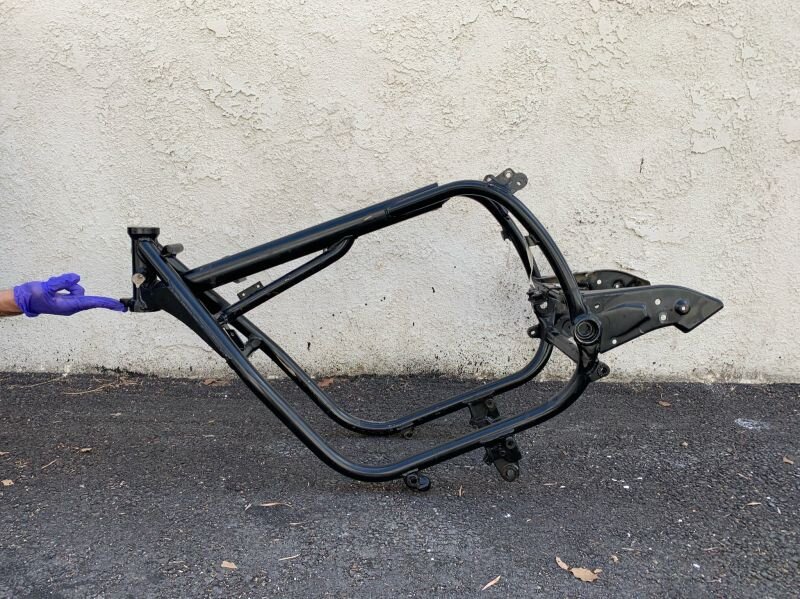
Speaking of passing milestones, shortly after submitting the book I reached a big one with my custom bike project: getting the engine and gearbox back in the frame and finally having a thing with wheels that looks like a motorcycle to roll out of the garage and take a decent look at. As you can see it’s come a long way from the naked frame a few weeks ago.
It’s been so much fun learning all the new skills to get this far. I’d barely swung a wrench when I started this project, let alone stripped and rebuilt an engine and carburettors, replaced a diode board or painted a crank case, but it’s all prior art — you can just learn everything from books, youtube or calling a pro if you get really stuck.
The only things I’ve had to pay people for so far have been powder coating, rebuilding the gearbox, replacing the valves, and re-building the front forks. Next up is all the electronics and controls then we’re pretty much good to go. Oh and a seat.
Anyway, I’m really pleased with it so far, and the kids on my block tell me it looks “f***ing sick” which is ironic given the bike has been in perfect self-isolation for ten months. Two nations divided by a common language and all that…
See this post on LinkedIn