
These posts are duplicated from LinkedIn, where they’re seen by tens of thousands of people each week. They often spark lively, valuable debate and your voice would be welcome. Visit my profile to connect with me.
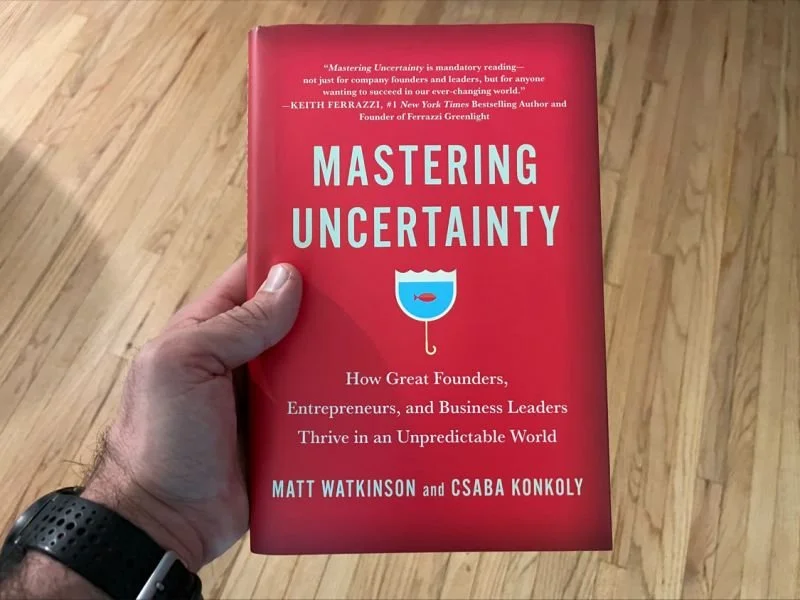
Today’s the day! Mastering Uncertainty is officially on sale in the US! 🇺🇸
If you’ve pre-ordered it should arrive within a day or so, and if you haven’t there’s a link to the Amazon page in the comments.
I can’t wait to hear what you think of this book and I’m beyond grateful for the opportunity to have worked with my co-author Csaba Konkoly, Matt Holt, and the rest of the team at Matt Holt Books on this project.
I could not be more proud of the result and say with absolute confidence it is the best of the three books I’ve written to date.
Thanks for your support!
See this post on LinkedIn
Hello everyone! I'm heading to London today and will be floating around the UK until the 13th April to promote our new book Mastering Uncertainty — OUT THIS THURSDAY BY THE WAY. Shoot me a message if you're around and want to get together. There's some down time in the schedule!
#socialnotworking
See this post on LinkedIn
7. Remember: you are doing it too
Dear Marlowe,
Once I was complaining to a mentor about somebody’s behaviour that I found objectionable. They were reckless, I said. Irresponsible. They were being careless with someone else’s money.
His response stopped me in my tracks: “Why don’t you tell me all the times that you’ve done those things?”
At first I protested, but he kept pushing me to tell him, and you know what? Turns out I’ve done those things a lot too over the course of my life.
From that moment on, whenever I found myself angered by something, I recalled the times I’d been guilty of the same charge.
Sure, there can be degrees of magnitude. But the point is that everything is in all of us, and the things that annoy us most about others are often the things we like least about ourselves.
I have found that reflecting on this in the moment has made me more compassionate with others, less quick to judge and far less quick to anger. You may find the same.
Love,
Dad
****
Letters to Marlowe is a personal project to pass on valuable life advice to my son.
See this post on LinkedIn
Plenty of people believe that ChatGPT and other AI/ML technologies will wipe out swathes of white collar jobs. Not so fast.
We’ve had technology at our disposal for decades that could easily have eliminated vast numbers of jobs through streamlining, automation, and putting computation to good use. How have we responded to those advancements in reality?
It’s not been through massive efficiency gains — there’s an estimated $2bn a year in admin waste in the US healthcare system alone — and your own experience of the workplace will probably confirm that the teflon-coated, ultra-modern, tech-driven enterprise is a myth.
In reality everything is held together with duct tape, cludges, workarounds and human labour because replatforming is expensive, doing things the right way takes too long and is too hard, and we tend to stretch what we’ve got rather than build new stuff. That isn’t going to change overnight because we’ve got a shiny new object to play with.
Neither have we been busy using technology to eliminate jobs. Quite the opposite. Instead we’ve just created ever more meaningless jobs to keep people occupied.
As David Graeber wrote five years ago in his awesome book Bullshit Jobs: “A YouGov poll found that in the United Kingdom only 50 percent of those who had full-time jobs were entirely sure their job made any sort of meaningful contribution to the world, and 37 percent were quite sure it did not…we can probably conclude that at least half of all work being done in our society could be eliminated without making any real difference at all.”
The reality is that people need something to do. And people also actually quite like having other people around. Furthermore, a manager without people to manage isn’t really a manager at all. There is no seniority without juniority, and every social organization, including a business, has a hierarchy whether we like it or not.
What’s the first thing any new manager does? Build a team beneath them, whether there’s work for them to do or not. Once they have the people they can find work for them to do, obviously.
Rational business cases are no match for human nature. And fast moving technologies rarely deliver on their promise when confronted with slow moving cultures. A huge number of jobs are already meaningless and could have been automated away but haven’t. I’d be very surprised if ChatGPT made much of a difference — even though on paper it probably could.
#technology #ai #chatgpt
See this post on LinkedIn
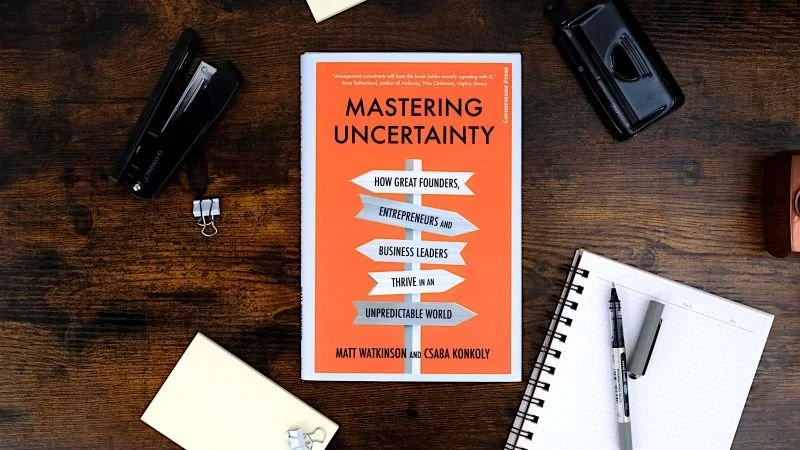
For every success there is story A and story B.
Story A is a tale of hard work, prescient insight and clever strategy.
Story B is how we found ourselves in the situation where story A could take place — the chance encounters, people we met, and serendipitous discoveries that put us in the right place at the right time.
Without story B, there is no story A, as my own life clearly demonstrates:
If I hadn’t met Csaba Konkoly at a party, we wouldn’t have written a book together.
If I hadn’t met Ben Smith on a project in Milton Keynes, we wouldn’t run a business together.
Story A hogs the limelight, but Story B is what makes every success possible in the first place.
That’s why increasing your luck surface area — by building relationships, paying it forward, trying more stuff, or sharing your interests more broadly — does far more to increase your odds of success than gobbling down ever more academic business advice, crafting more detailed plans, or gathering more data to analyze.
Set the stage for more serendipitous encounters in life, and you’ll be amazed at what can happen.
This is a key theme in Mastering Uncertainty, out at the end of this month!
Ps. Check out the UK edition hardback cover 😎
#entrepreneurship #decisionmaking #strategy #relationships
See this post on LinkedIn
If you have a goal, ambition, bucket list item, or skill you’ve always dreamed of learning, please take a ten second break right now and answer this question:
What is the first step I would need to take to begin?
You’ll probably be surprised to discover that it’s absurdly easy:
Google “Clarinet lessons in Leicester”
Drive to the store and get some running shoes
Research flights to Kenya
A common reason we don’t accomplish big objectives is because we don’t start, and the reason we don’t start is because we gaze off to the finish line and begin to envisage all the obstacles or challenges we might face along the way.
We start to strategise and analyse, and before we know it we’re so overwhelmed by the imaginary journey ahead that we just do nothing instead.
The solution is to recognise this: you build momentum by building momentum, as my friend Csaba Konkoly likes to say.
One easy step, then the next, then the next. Before you know it the boulder is moving and the obstacles get crushed underneath it.
Now…given how easy that first step is, maybe just take it today and see what happens.
#mindset #learning #enterpreneurship
See this post on LinkedIn
When I was 18 I boarded a train to Oxford to meet a friend for a drink. Someone had left a newspaper on the seat opposite me and — absent any other distractions — I started leafing through it.
I was looking for a job at the time so when I saw a high paying sales role advertised I decided, for no real reason and with little hope of success, to apply for it.
Well, I got the job and was terrible at it — I was fired within a couple of weeks. But I also crossed paths with Hayden Sutherland who told me to go to university instead, and became my first career mentor.
When I showed an interest in web design, Hayden introduced me to a friend of his, Ed Texier, who was a great designer and had just launched his own agency. Tex took me on and under his watchful eye I developed my UX/UI skills which eventually led to me getting my first contract role immediately after graduating — back with Hayden, re-designing P&O Ferries website.
At P&O I met Phil Leitch who got me a job at the consulting firm where he worked, when that project ended. I learned an insane amount from Phil — lessons I still apply today — but the job didn’t really work out.
Fortunately another colleague there introduced me to Nish Kotak, who put me in touch with Emma Robertson who hired me to help on the redesign of Argos.co.uk, where on my first day I sat down next to one Ben Smith who — sixteen years later is my business partner and best friend.
I reflect on this experience often and keep coming back to three big lessons:
1. You don’t succeed if you don’t try
If I hadn’t applied for that idiotic job I probably wouldn’t have the career I do today. If there’s no downside to something there is no reason not to try.
2. It’s who you know
Forming good relationships with people massively increases your luck surface area. I'd be in a very different place without the people mentioned above who gifted me each opportunity.
3. Success has as much to do with serendipity as strategy
Having a fixed plan can make you blinkered to unexpected opportunities that might be even better. Be open to opportunity!
See this post on LinkedIn
6. If you wouldn’t seek their advice, don’t heed their criticism.
Dear Marlowe,
The world is full of critics.
People who don’t even know you can say hurtful things about you, and people who have never even seen your work can speak ill of it. It’s a fact of life, and it can be very discouraging and painful. There is a simple solution to this problem though.
When confronted with any form of criticism ask yourself: Would I seek out this person’s advice? Would I pay for their opinion? If the answer is no, you can disregard what they say immediately. It doesn’t matter one iota what they think of you.
If you wouldn’t seek their advice, don’t heed their criticism. Focus on the people whose opinions you respect and have your best interest at heart, act on their advice or feedback, and ignore the rest.
Love,
Dad.
****
Letters to Marlowe is a personal project to pass on valuable life advice to my son.
See this post on LinkedIn
Contrary to popular belief, successful entrepreneurs are quite risk averse and their corporate counterparts are often absurdly reckless. How so? Here are seven ways:
1. Entrepreneurs work on the basis of affordable loss, rather than promising a definitive ROI. This limits their downside, keeps their plans flexible and stops them throwing good money after bad.
2. Entrepreneurs only care about what works in practice, not what works on paper. By contrast corporations will often sign off on $Xm projects based solely on some eye candy in PowerPoint, supported by generic, desk-based research.
3. Entrepreneurs are willing to learn and adapt, whereas managers within large corporations tend to stick to the plan, even when it becomes obvious that its fundamentally flawed.
4. Entrepreneurs start selling earlier — considering the sales process as a form of research. Corporations often foist new products onto their sales teams with little idea whether people will want it.
5. Entrepreneurs get traction then optimize. By contrast, large organizations often invest insane amounts polishing products or services when there isn’t yet any proven demand.
6. Entrepreneurs care mostly about whether now is the right time for a new product or service. Corporate types tend to think timing is largely irrelevant as long as they have the right features and price, so often enter the market too early or too late.
7. Entrepreneurs focus on what creates the most value for the customer. Corporate types tend to fuss over unique selling points or differentiators, which have comparatively little appeal to customers and narrows the potential buying base.
So there you have it. In reality entrepreneurs are comparatively risk averse. Or to put it another way, they embrace uncertainty as part of their process.
All of this and much much more is explained in Mastering Uncertainty — cowritten with the mighty Csaba Konkoly — out at the end of this month.
#entrepreneurship #strategy #innovation #management
See this post on LinkedIn
It is a universal theme that every technology creates a problem in place of the one it solves.
Air travel allows us to experience the world easily but creates pollution and allows diseases to spread globally in days.
Single use packaging is cheap and convenient but creates mountains of waste.
Smartphones are incredibly useful, but have created perennial distraction and an inability to decouple from work.
Internet technologies like cookies can (in theory) help us improve user experiences but have compromised our privacy.
Social media usage allows us to exchange ideas with a global audience, but has a clear connection to anxiety and depression.
Electric vehicles have no tailpipe emissions, but require extracting more resources from the earth, put strain on the power grid and have major recycling issues.
Amazing advances in medicine allow us to live longer, but an aging population is another challenge.
ChatGPT will be no different. It will carry benefits but will no doubt also create problems that will be lucrative to solve.
Like every other technology it therefore presents two areas of opportunity: how do we make use of the technology itself, and how do we work to address or offset the problems it will create?
Given the explosion of interest in IA, Machine Learning and other technological advances that we hapless apes seem to find so enthralling, W.Brian Arthur’s book — The Nature of Technology — which explores this topic in considerable detail, is a very timely read that I highly recommend.
Ciao
See this post on LinkedIn

Given that this rogues gallery of Forbes covers has gone viral, it seems that many people are not aware of the availability heuristic. What is it?
In a nutshell it means that information we can more readily recall weighs more heavily in our decision-making.
Most people think more words begin with “r” than have “r” as the third letter because they’re easier to remember, for example. We also overestimate the number of Hollywood divorces because we hear about them more.
We also tend to ascribe our success to hard work because we are very aware of the obstacles that we have had to overcome. And we rely on first hand experience more heavily than other sources of information. If a friend had an extreme adverse event to a medical treatment like a vaccine, for example, this influences whether we get vaccinated far more than looking at a bigger sample size.
In the case of the Forbes covers, because over the last several years they featured Elizabeth Holmes, Sam Bankman Fried and Adam Neumann the conclusion is that Forbes only puts reprobates, con artists and fraudsters on the cover because we remember these people more easily on account of their misdeeds. But Forbes have probably done over 800 covers which makes these three individuals 0.375% of the sample size. An extremely low error rate indeed.
It’s not hard to see how this bias affects our decision-making. Mistaking what is recent and salient, or our first-hand experience for what is accurate, representative or statistically significant wreaks havoc with our risk calibration and judgement, often causing us to leap to the wrong conclusion or launch into erroneous courses of action.
Incidentally this topic and the hindsight bias — which is also heavily present in people’s reaction to the covers — are explained in some detail in my forthcoming third book, Mastering Uncertainty, so the timing is opportune!
See this post on LinkedIn
5. When things go wrong, simplify
Dear Marlowe,
“When things go wrong, simplify.”
I’ve never forgotten this quote from a book on weight-lifting I read by Dan John in my mid twenties.
When we find ourselves underperforming, or when we find ourselves in a difficult situation, we tend to make things more complicated. We craft elaborate strategies. We over think. We fill our days. We drown in detail. Doing the opposite works better in practice.
If I am trying to master or develop a skill and reach a plateau or find myself regressing, I return to the fundamentals.
If I feel overwhelmed I return to the foundations of a good life — sleep, diet, exercise, good company, and activities I love.
If I find myself in a challenging situation, I look at what I can do less of or eliminate entirely to allow me to focus.
When things go wrong, simplify.
Love,
Dad.
****
Letters to Marlowe is a personal project to pass on valuable life advice to my son.
See this post on LinkedIn
I’m heading to Vegas tomorrow for some long overdue track time on the bike. I highly recommend this hobby for a number of reasons.
1. It is bullshit free
The stopwatch doesn’t lie. You’re either fast or you’re not, and no amount of boasting on social media or in the pitlane will change that. You can also measure your progress very easily as a result.
2. You learn self awareness
If your confidence exceeds your ability you will crash and it will probably hurt. A good thing to learn in general.
3. You gain perspective
It’s easy to get wound up by trivial stuff in life. Start riding a motorcycle as fast as you can and you realize that as long as nobody gets hurt whatever it is, it’s probably not that big a deal.
4. Inner peace
Contrary to popular belief track riding is a very zen experience — almost like a ballistic form of yoga — and you can’t ride well if you are not relaxed. I also have a very noisy mind full of chatter. That all disappears when you’re doing the length of a soccer pitch every 2 seconds.
5. You learn to manage your emotions
Fear is part of riding. Getting faster means going out of your comfort zone. Unexpected, scary stuff can happen. Learning to stay calm is a very valuable skill. Also getting hot-headed or carried away is a recipe for disaster.
6. You feel like a god, even when you’re not
After a few laps you melt into the bike and it becomes a sort of omnipotent fifth limb. All that power available at the twist of the wrist — well it’s a lot of fun.
One final word of advice for anyone else into motorsports, bikes or sports cars. Always remember: the finish line is at home. xx
See this post on LinkedIn
It famously took James Dyson over 1,500 prototypes before his bagless vacuum cleaner worked.
It also took Sony three years until they had a successful product. They considered making a miniature golf course, miso soup and launched a rice cooker that didn't work in the early days.
J.K. Rowling’s Harry Potter books were rejected by twelve publishers (so was my first incidentally).
Henry Ford was bankrupted twice before Ford motors succeeded.
Chung Ju-yung — the founder of Hyundai — ran away from home in North Korea four times just to be able to get a job at all.
In reality people do not craft a hit product on paper using elaborate strategies, clever market positioning, and other academic puffery.
Instead, most successful entrepreneurs, visionaries, or creative giants simply have the tenacity and adaptability to keep going until they succeed, regardless of the setbacks along the way.
#entrepreneurship #strategy #innovation
See this post on LinkedIn
James Clear’s book Atomic Habits has sold a whopping 10,000,000 copies. He’s a great writer, a savvy marketer and the ideas are useful. But nobody of sound mind would suggest Atomic Habits is 200 times better than a book that sells 50,000 copies, which would still be a massive success in publishing.
Elon Musk’s net worth is currently $262bn — he’s taken a lot of risks, is certainly intelligent, and works extremely hard by all accounts. But again, nobody would suggest he is 262 times harder working, smarter or better at his job than an entrepreneur whose net worth is only $1bn.
It is tempting to think that there must be something special about people who achieve extraordinary results — whether they’re artists, entrepreneurs or just people with a huge social media following. That they must have something that we don’t — a supernatural ability of some kind. But the reality could not be further from the truth. The only truly extraordinary thing about them is how lucky they are.
An ingenious study by Professor Alessandro Pluchino and his colleagues at the University of Catania demonstrated exactly this, simulating real world diversity of talent and wealth distribution over a theoretical 40 year period.
“The maximum success never coincides with the maximum talent, and vice-versa,” they concluded. “It is evident that the most successful individuals are also the luckiest ones, and the less successful individuals are also the unluckiest ones.”
This insight serves three purposes.
It should keep the ultra-achievers among us humble and counting their blessings.
It should prevent everyone else from thinking that if we follow their prescriptions for success we will get similar results, because we can’t replicate their good or bad fortune, serendipity, or circumstances.
Finally, we should never compare ourselves to the best of the best and find ourselves wanting because while wealth is visible, luck — good or bad — typically is not. We just need to keep doing our best to fulfill our potential, while doing what we can to create our own luck.
My third book — Mastering Uncertainty, co-written with Csaba Konkoly — which explores these topics and many, many more is out at the end of this month.
#entrepreneurship #innovation #growth
See this post on LinkedIn
It took me fifteen years to learn a fundamental lesson that they don’t teach in business school:
Your success in business depends far more on your relationship with uncertainty than pretty much anything else.
Think about it for a second.
It doesn’t matter how great your startup idea is if you won’t try because you’re uncomfortable taking risks.
It doesn’t matter how much potential you have, you’ll never fulfill it if you’re paralyzed by fear of failure.
It doesn’t matter how good your product is if you won’t try to sell it because you’re afraid of hearing no or how people will react.
And however intelligent you are, however cogent your strategy is, however much data you gather or analysis you do, unexpected events will always occur. As the military expression goes, “The first casualty of war is the plan.”
If you won’t adapt your plan or vision in response to real world events — in particular what the market or customers are telling you — you’re doomed to fail.
Those who accept and embrace uncertainty rather than constantly trying to eliminate or expunge it have a massive advantage in business.
They try more things, experiment more broadly, are more adaptive, more open-minded, more receptive to feedback, learn more, and as a result, limit their potential downsides while creating potentially unlimited upsides for themselves.
The good news is I’ve taken the stairs so you can take the elevator.
My new book with Csaba Konkoly, Mastering Uncertainty — which teaches you exactly how to thrive in an unpredictable world — is out at the end of this month.
I can’t wait to hear what you all think of it.
#startup #entrepreneurship #strategy
See this post on LinkedIn
4. Make friends with the other side
Dear Marlowe,
You will often encounter people who have very different opinions to you on something. They might have completely opposing political views, or beliefs about the world that seem crazy to you.
In such circumstances it is easy to see things in black and white. To polarize. To succumb to a “them and us” dynamic. To write them off completely. This is unhelpful.
Instead you must recognize that someone’s opinion on one topic does not define their whole persona.
We usually have a lot more common ground than we realize, and we can learn something from everyone. Better yet, in building respectful friendships with people of opposing views we can become more open-minded, empathetic, and less quick to judge. All these are good things.
Love,
Dad.
****
Letters to Marlowe is a personal project to pass on valuable life advice to my son.
See this post on LinkedIn
Not content with watching Frozen Two at least 87,943 times with my kiddo, I recently watched the six part making-of documentary on Disney Plus too.
It gives a fascinating glimpse into the creative process behind one of the most successful movies of all time and I highly recommend it. Here are six takeaways that I think all sorts of product development teams could do well to embrace:
1. Good ideas can come from everywhere.
People from any department felt that they could contribute ideas to the project that might improve it, whether it was their direct purview or not. The song writers, for example, made valuable contributions to the story line, and the animators had some great character ideas.
2. Expert peer review adds a lot of value.
The executive team had a brain trust of award-winning directors who critiqued the film at various stages throughout its development to help improve it. A fresh set of eyes can be invaluable, especially those of other highly successful subject matter experts.
3. Focus on what makes the product better.
The receptiveness to critique and feedback — however painful — was amazing, and some people had months of their work cut as the storyline changed. Nobody minded too much. Why? Because they’re focused on what makes the product the best it can be, not their fragile little egos.
4. Belief in the project matters.
These people work extremely hard under tremendous pressure. The reason they can do this is because they believe in their work, the impact they can have, and that they’re making something extraordinary.
5. Act on customer feedback.
The audience screening took place with ample time to incorporate the feedback, rather than as a box-ticking exercise before launch. They also actually changed stuff in response to the feedback — imagine that!
6. Iterate and adapt.
The storyline was still changing just a few months before release. Songs were being written or edited, scenes were being added and cut as they responded to feedback. A far cry from the common practice of setting a vision and sticking to it, even if changes would be for the better.
Is it any wonder Disney consistently makes amazing movies?
#innovation #productdesign #teamwork
See this post on LinkedIn

It was an absolute pleasure to host the inimitable Rory Sutherland and Anna Cairns yesterday.
For anyone who has not read Rory’s book Alchemy, listened to his TED talks, or read his Wiki Man column for The Spectator you are really missing out.
p.s. If you’re in LA and want to hang out let me know. It's an open invite!*
*On the assumption you’re not trying to sell me either guaranteed lead generation services that can quadruple my turnover in 48 hours, or your elite team of offshore software developers.
See this post on LinkedIn