
These posts are duplicated from LinkedIn, where they’re seen by tens of thousands of people each week. They often spark lively, valuable debate and your voice would be welcome. Visit my profile to connect with me.
Imagine you run a factory that makes lamps. A complete lamp needs three parts, each made by a different machine. Two of the machines make 30 parts an hour, but the other one only makes 15. If you want to make more lamps per hour which machine should you improve?
Obviously the one that only makes 15. Improving the other two won’t make any difference because they aren’t the constraint that limits your throughput.
Now let’s imagine you run a business and what you’re trying to grow is revenue. There are many "machines" involved: advertising, sales, customer service, product development, etc.
Should we spend more advertising a product that nobody wants? Should we improve customer service if nobody has heard of us? Should we drive more customers into the top of the funnel if they drop straight out of the bottom?
The analogy is imperfect but the basic point remains — not all opportunities have an equal payoff. Just because we can do something doesn’t mean we should. We should also be extremely wary of specialists who know only one thing. Those inside a particular machine usually don't know if they’re the constraint or not.
As Buffett says, don’t ask a barber if you need a haircut. Instead try to see the system as a whole, determine the biggest constraint, and attack it!
See this post on LinkedIn
I first heard about the GASP Agency podcast when not one but two of my friends — Rory Sutherland and JP Castlin (formerly Hanson) — appeared on episodes, so I was delighted when they invited me on for an interview.
The discussion covers both books — The Ten Principles Behind Great Customer Experiences and The Grid — general lessons about customer experience and strategy stuff, and my somewhat haphazard career trajectory.
Have a great weekend all!
See this post on LinkedIn
The English dictionary contains about 170,000 words — enough to allow nuance and specificity, regardless of the circumstance. An English summer’s day can be described as inclement, bleak, dreary or typical, for example.
It’s odd then, that the business lexicon is not only absurdly narrow, but consists almost entirely of words whose defining characteristic is ambiguity: innovation, culture, disruption, transformation, value, and marketing are words we use daily, without a clear and shared idea of what they mean.
By constraining ourselves to a narrow, abstract vocabulary, we also constrain our thinking, creativity, ability to execute, and with that, our potential. It also means the majority of what we read at work is indescribably dull. TL;DR is more often than not TOO F'ING BORING; DR.
The problem is easy to fix.
Start by imagining that you're talking to your grandparents rather than a Gartner analyst. Next, imagine that what you have to say is really very interesting and important — how could you make it stick in the reader’s brain? Use an analogy? Tell a story? A humorous turn of phrase? Some quirky adjectives?
Most of business is communication. Good writing stands out, exerts influence, saves time and leads to action. It's well worth the effort, in other words.
See this post on LinkedIn
Last post on this! The COVID-19 Business Battle Plan is now available in 11 languages: English, German, Spanish, French, Italian, Dutch, Polish, Portuguese, Romanian, Slovakian and Thai — thanks to a team of amazing volunteers.
A talk on the battle plan is also raising money for The Samaritans through isolaTED talks. It's been a good week!
Huge thanks to Simon Robinson, Matías Gadda Thompson, Ray, Pat, Maria Cristina Scazzola, Magda, Anastazja, Daniel Martinez, Sergio, Mitzi Lagerweij and of course David Müller who had to put up with Ben Smith throughout.
Finally, a special shout-out to Rupert Foster, Iris van Oudvorst and the Codex Global team for their help in getting this out in even more languages than we’d hoped for. The Grid looks totally wild in Thai.
If you think anyone can benefit from this free set of worksheets and tools to assess the impact of COVID-19 on their business, and plan a path forward, please share the link (methodical.io/battle-plan/)
Cheers!
See this post on LinkedIn
The media — social and otherwise — is awash with expert proclamations about how the world will be different when the current pandemic subsides. You're probably best off ignoring these predictions.
After analyzing 28,000 expert predictions, Philip Tetlock concluded: "Despite massive investments of money, effort and ingenuity, our ability to predict human affairs is impressive only in its mediocrity."
He continues, "The average expert's forecasts were revealed to be only slightly more accurate than random guessing, only a bit better than the proverbial dart-throwing chimpanzee. And the average expert performed slightly worse than a still more mindless competition: simple extrapolation algorithms that automatically predicted more of the same."*
We're better off accepting that nobody has a clue what the future holds and surrendering to uncertainty.
Instead of trying to control the uncontrollable, we can instead find comfort in a fundamental truth: that whatever the future brings, there will be opportunity for those who remain adaptable and responsive, are willing to roll up their sleeves, and set out to create value for others.
*Tetlock, P. et. al. (2011) "What's Wrong With Expert Predictions " Washington D.C.: Cato Unbound
See this post on LinkedIn
I strongly encourage you to visit this awesome website: isolaTED talks — where a heavyweight roster of luminaries from advertising, marketing and beyond have donated talks recorded in isolation at home to raise money for the Samaritans.
Don't be put off by my presence there — this lot are the crème de la crème. A physical conference with a line up like this it would cost a small fortune to attend, but you can just make a small (optional but encouraged) donation.
A wonderful initiative from Giles Edwards at Gasp — a bon oeuf if ever there was one.
See this post on LinkedIn
The Stratocaster guitar is a design masterpiece. A true icon. But perfect? No. Fender products were designed to be manufactured cheaply at scale, not to be the best guitars possible. So it seems surprising that attempts to improve it have largely failed.
Why is that? As a master guitar builder explained to me, by removing the flaws, refining the construction or quality of materials, the tone often moves further away from what people want. Instead of becoming a Stratocaster but more so, it can start to sound soulless.
Consider another icon, the Porsche 911, whose design is not merely imperfect, but fundamentally flawed. The engine — hung out past the rear axle — is in the wrong place according to physics, yet they’ve sold over a million of them. Leica's current M-series camera is another example. It relies on a cumbersome manual focus system that seems willfully anachronistic these days. But there's a long waiting list if you fancy one.
What's the point?
Following trends and best practices, or seeking ever-greater performance can be to our detriment if we lose our distinctiveness, or — worse still — lose sight of what makes us us.
Our quirks — as organizations or individuals — are often our strengths. As Dr. Seuss put it, "You have to be odd to be number one."
See this post on LinkedIn
The first in a long line of menial jobs I held was scanning documents and sending letters for an actuarial business in Oxford. I toiled from nine to five in a barren, overflow office feeding incomprehensible paperwork into a scanner; ending the day by printing and posting letters.
There was nothing to alleviate the monotony, and had there been, I wouldn't have used it. The prospect of being distracted and making a mistake was not a good one.
My overlord was a fiend for quality and — despite being the boss of the whole business — would visit my shabby chambers periodically to make sure the work was up to snuff.
What qualified as a mistake? If a postage stamp was not equidistant from the top and side edges of the envelope at 5mm (+/- 1mm was probably tolerable) I would have to re-do it. This boggled my tiny mind. Wouldn’t the envelopes get bent in the mail anyway? Would anyone notice?
The point, he explained, was that if quality matters anywhere it matters everywhere. Start making concessions and you'll never stop, but if you never allow quality to slip anywhere, you'll never have to worry about it slipping in the wrong places.
Two decades later I remain grateful for the lesson. Oh, and if I ever mail you anything, look at where the postage stamp is...
See this post on LinkedIn
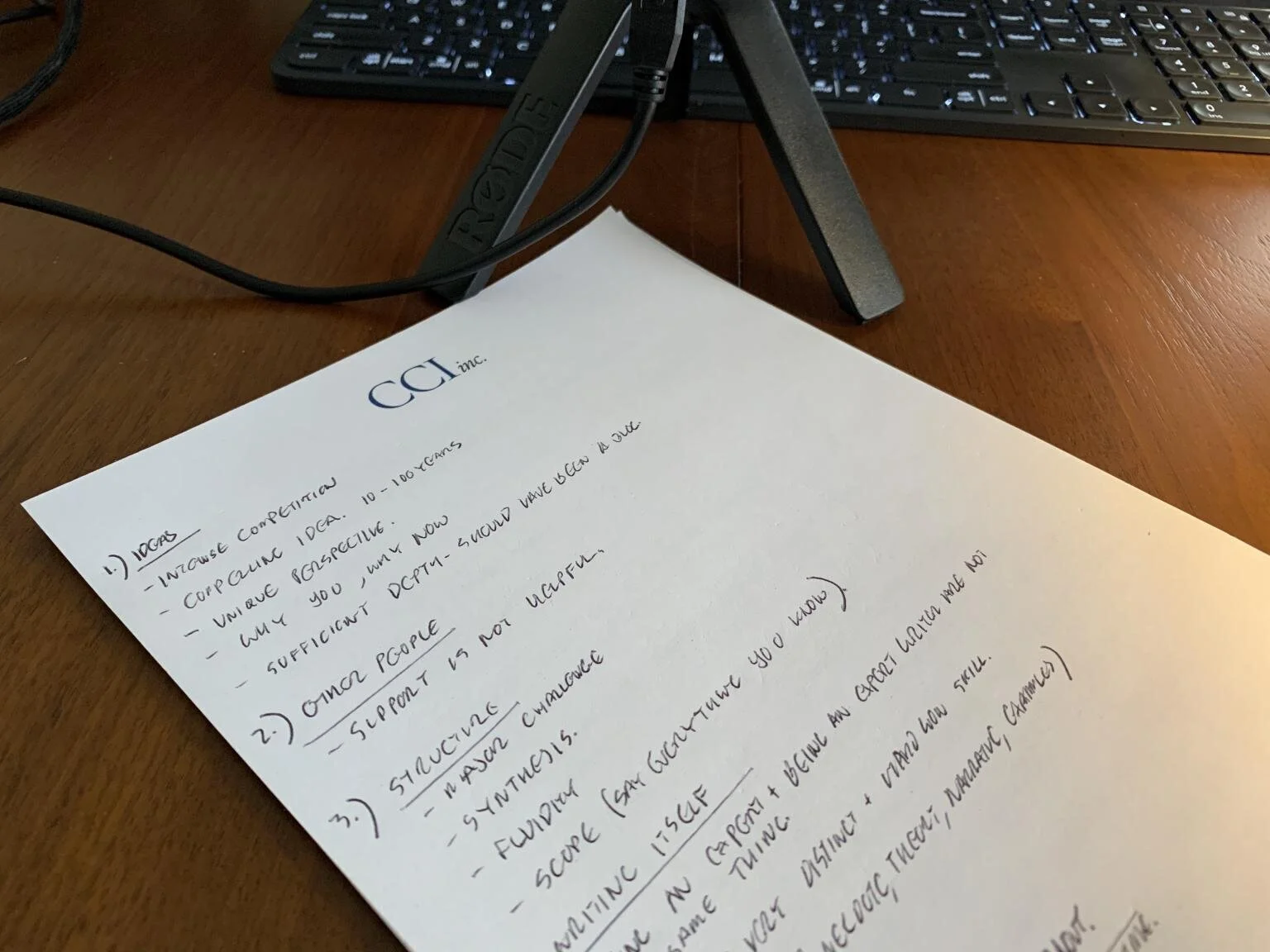
Last week I posted some advice about writing business books, and had enough comments and messages in response to warrant an expansion, so I've recorded a podcast on the topic. As before, I've done it in one take with no editing, as a form of training for impromptu, slide-free presentations.
I explain six key challenges to writing a good business book:
1. Having a genuinely good idea
2. Your supportive friends are unhelpful
3. Defining the structure and scope
4. The act of writing itself
5. Exhaustion and burnout
6. Things will inevitably go wrong (most writing is re-writing)
Then, having rained all over your sails and taken the wind out of your parade, I suggest what you can do to overcome these problems, including:
Being clear on your motivation
Practising writing and reading critically
Why you should design a book rather than write it
Structural tips including the SCQA format and pyramid principle
Why professional publishing beats self-publishing
Proposal writing
Learning to love the process, not the outcome
Forming a brain trust
Available on Spotify, iTunes, Soundcloud,
Please subscribe — I'm starting to quite enjoy this podcasting business!
See this post on LinkedIn
The COVID-19 Business Battle Plan has taken off like a rocket — and now Codex are translating the resources into French, Italian, German, Dutch, Romanian, Catalan and Thai! As undesirable as the current situation is, people are really collaborating and supporting one another in some amazing ways — we're capable of so much when we work together. THANK YOU CODEX! 👏👏👏
See this post on LinkedIn
Many are deciding that now’s a good time to write a book. If that’s you and it’s your first time, some advice. Do not self-publish — you’ll inadvertently bypass the quality filters that make a book worth reading. To explain:
Respectable publishers often rely on literary agents as the first quality filter. If a proposal makes it past their critical eye, it’s at least worth considering.
Once you’ve inked a deal with the publisher, the editor adds the second layer of quality, making sure the structure and prose meet professional standards. It’s easy to include reams of flabby, self-indulgent flim-flam. A skilled editor will save you from yourself. Self-publishing doesn’t have these safeguards. Add in the indexing, fact-checking, typesetting, cover design, etc. and the difference in quality is always palpable.
For most business writers, royalties are inconsequential compared to the credibility boost, which is related to the quality of the book, not merely its existence. So instead, take this time to work on crafting a book proposal, not the book itself. Perfect your idea and the structure, and give the professional route a go.
Most underestimate just how difficult writing a book is. Trust me, you'll want all the help you can get on your first crack at it.
See this post on LinkedIn
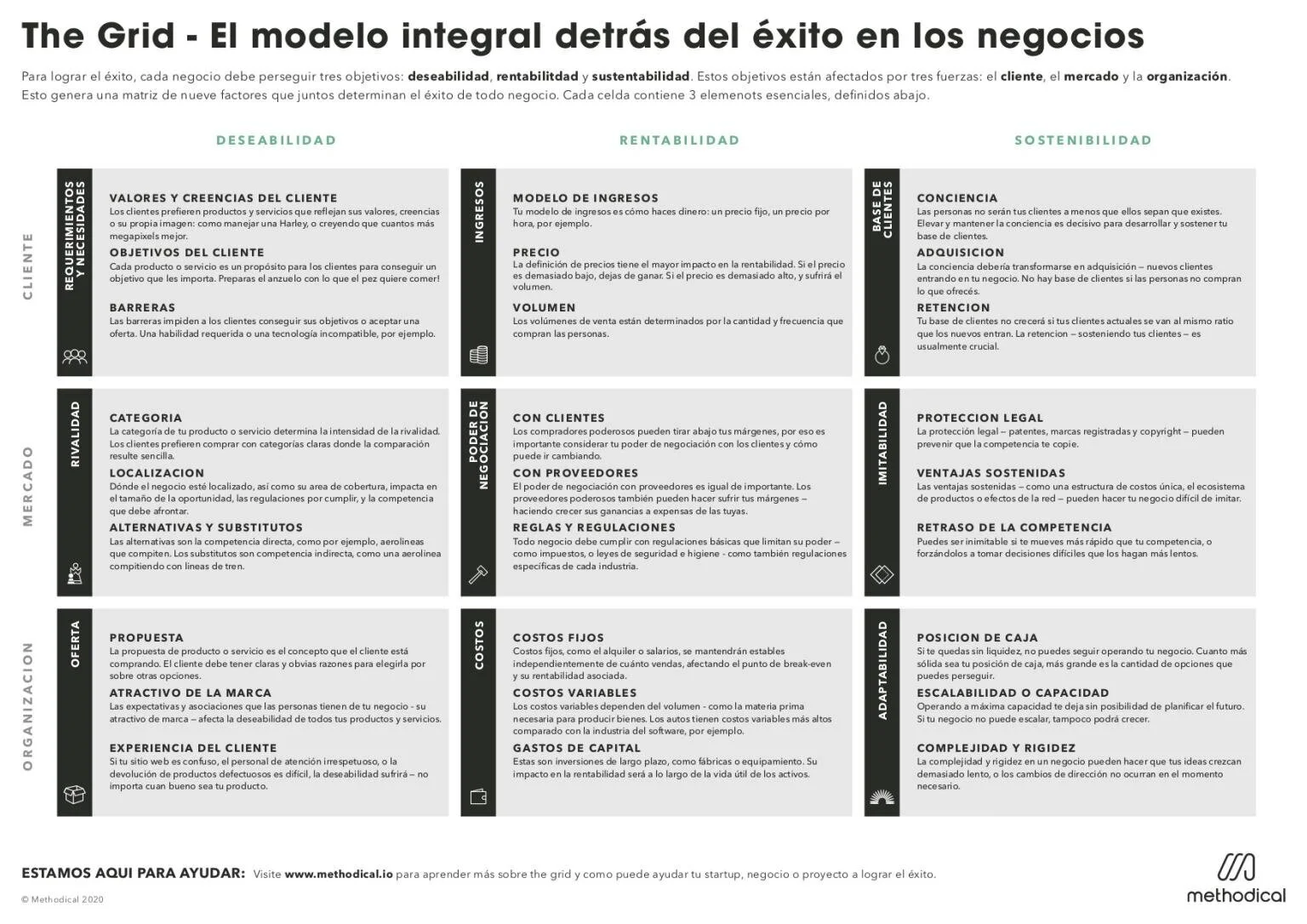
The response to the COVID19 Battle Plan worksheets has been absolutely awesome! So many people have shared them but — quite unexpectedly — they've also offered to help translate them. Portuguese and Spanish are already well under way!
If you want a copy to share in your language and you've got a bit of downtime you can just go to this google sheet, put your language at the top of a column and work through the tabs and we'll produce the worksheet pack and grid summary for you.
Here's the link if you feel like doing some translation
Thanks for the incredible response so far — thousands of people have already seen this post so the tools should be finding their way into the right hands...
Huge thanks also to those who helped us put the worksheets together in the first place — we won’t name all of you, but you know who you are! Special shout-outs to Mitch Wenger, David Müller, Gabor Eszenyi, Matt Tane, Arthur Nurse, Megan Butler, Bryan Russett and of course the brains of the outfit, the one and only Ben Smith. Your feedback on our early drafts and document wrangling helped enormously!
See this post on LinkedIn
🚨PLEASE READ.🚨
Many businesses are suffering as a result of the current pandemic. Some of our friends have already lost their jobs.
Many people also want to help, but aren’t sure how. We’re all facing different challenges, so there are no one-size-fits-all solutions.
To that end, we’ve spent the last few days working on a set of custom worksheets based on the grid — our simple but rigorous strategy framework — that can help you:
- Perform a clear-headed impact assessment (regardless of what your business does)
- Identify potential solutions to your unique challenges
- Prioritize what’s most important and get to work
There is also a YouTube tutorial that goes with it.
If we can help a few businesses stay afloat, or some more people keep their jobs, it was worth it. If you think this can help anyone in your network, please share this post or the worksheets themselves.
You can download the worksheet pack here
Cheers, and stay safe!
See this post on LinkedIn
After yesterday's post on adaptability I was inundated with a request to expand on the topic, in case it might help some people at the moment. So as a bit of an experiment I sat down and recorded an unscripted monologue on the topic.
It's a bit on the long side — one take, no editing! — so if you'd like to jump to a specific section you can:
1:00 - The current adaptability crisis
3:45 - Why adaptability matters
6:38 - Cash is reality
8:30 - How much cash do you need?
10:25 - Cash and employee experience
11:50 - The virtue of frugality
14:00 - Price optimization and sacrificing volume
15:20 - Cutting costs to build cash reserves
17:45 - Free cash flow - what it is and why it matters
21:10 - Working capital and freeing up cash
24:30 - Cost structures and their link to adaptability
29:00 - Do you have the right cost structure?
30:50 - Don’t trust people with high fixed costs!
33:40 - Capacity management and slack in the system
37:00 - The relationship between growth and complexity
42:00 - Never let the past look more appealing than the future
44:00 - Reframe challenges as opportunities
45:00 - Get started on the next thing earlier than you think
Full audio is here
See this post on LinkedIn
By far the most uncomfortable part of writing The Grid was researching the topic of adaptability.
Studying the rise and fall of empires and ecosystems forced me to reckon with just how crucial adaptability is and how drastically we undervalue it.
“Given the choice between maintaining adaptability and improving something else, adaptability is usually sacrificed.” I wrote. “And as with many things in life, you don’t miss it until you suddenly need it.”
What determines business adaptability?
Cash
If you run out of cash you can’t continue to operate the business. “Cash is a buffer that insulates you from change — buying you time to figure out what to do.” I wrote.
Scalability or capacity
The ability to scale up or down in response to changing demand is crucial, as is how effectively we manage our current resources.
Complexity and rigidity
Businesses tend to fail from the inside out, because of, “Operational and psychological baggage." That prevents us from responding to change.
Today many businesses face an adaptability crisis — too little cash reserves, too much rigidity, and major scaling issues have combined to devastating effect.
I deeply regret not speaking up about this topic more in the last year. It might have made a small difference to some.
See this post on LinkedIn
Intrigued by my totally logical/heretical ideas about customer experience, Mycustomer asked to interview me for their podcast and expand a little on the topics I've been writing about. If that sounds like something you'd like to listen to, here it is.
I personally will not be listening to it, because — like most people — I hate the sound of my own voice, so I'll have to rely on you to judge the quality of insight and delivery.
See this post on LinkedIn
Some generic advice for CXers who’ve been asked to prepare a thorough business response to COVID-19:
Gather an ad-hoc team with representatives from across the business — including front-line staff, corporate comms, business unit leads, and anyone else who understands the customer / category.
Work through each business unit, product line or customer role, considering implications for customers:
What are they expecting to happen?
What worries, stressors, or challenges are they facing?
What information will be most useful for them?
What would create the most value for them at this time?
What expectations of us must be reset or changed?
Filter or weight your insights / ideas by whichever prioritization criteria make sense, like:
Severity of impact
Immediacy of impact
Frequency of impact
Volume or % of customers impacted
Implement ASAP in priority order, relying on the judgment of those who know customers best.
Move fast and be responsive — actions speak louder than words.
Strike an empathic tone (duh).
Communicate what you’re doing and why clearly and unambiguously — don't make matters worse by confusing people.
Revisit as the situation unfolds.
Please share your own advice for our community in the comments — now's the time to help each other out a little.
See this post on LinkedIn
The subject of human memory — and its implications for design and customer experience — is endlessly fascinating. Take “state dependence” for instance.
The concept is simple: we remember things more readily that also occurred in our current state of mind. For example, if our partner does something that irritates us, our mind can easily flood with every grievance from the last decade. Arguments can easily escalate for this very reason!
From an evolutionary perspective you can see why this feature makes sense — immediate recall of similar events might help you out of danger. Closer to home though, the implications for customer experience are profound, because it seems to validate something that makes sense intuitively — the impact of interactions is cumulative.
Instead of treating each encounter as an isolated event, we end up with a mental filing cabinet labeled, “All the times my airline / accountant / etc. infuriated me." One incident triggers recall of the others, and a straw can easily break the camel’s back.
Two big implications:
1. Consistent quality matters enormously.
2. Tending to high-frequency gripes (however trivial) is vital, because their impact is accumulative — a crucial insight that's often overlooked when issues are prioritized!
See this post on LinkedIn
Many organizations claim to prize efficiency, agility and simplicity, but habitually overpay for complex solutions that take years to implement. Why?
Part of the answer is the unspoken yet implicit connection between status, budget and headcount.
Human beings are natural status seekers, and in large organizations our relative importance is often measured by our budget allocation and number of underlings (along with our job title).
Naturally then, leading a vast, resource-intensive program has greater cachet than a tiny, tactical one. Ask for some loose change for a small project and you risk seeming trivial, however big the payoff. But $20m for a total re-platforming and you'll be taken seriously. Worse still — spend less than your total annual budget and you'll be punished for it next year.
The net result is that many businesses systematically overlook small projects that could yield immediate customer or business improvements, in favor of Kafkaesque programs with glacial timelines, higher risks and questionable benefits — the very opposite of what they claim to want.
How many large-scale technology, CX, or rebranding initiatives are mandated by rank or protocol, rather than commercial logic or earnest desire for improvement? Not all, of course, but plenty!
See this post on LinkedIn
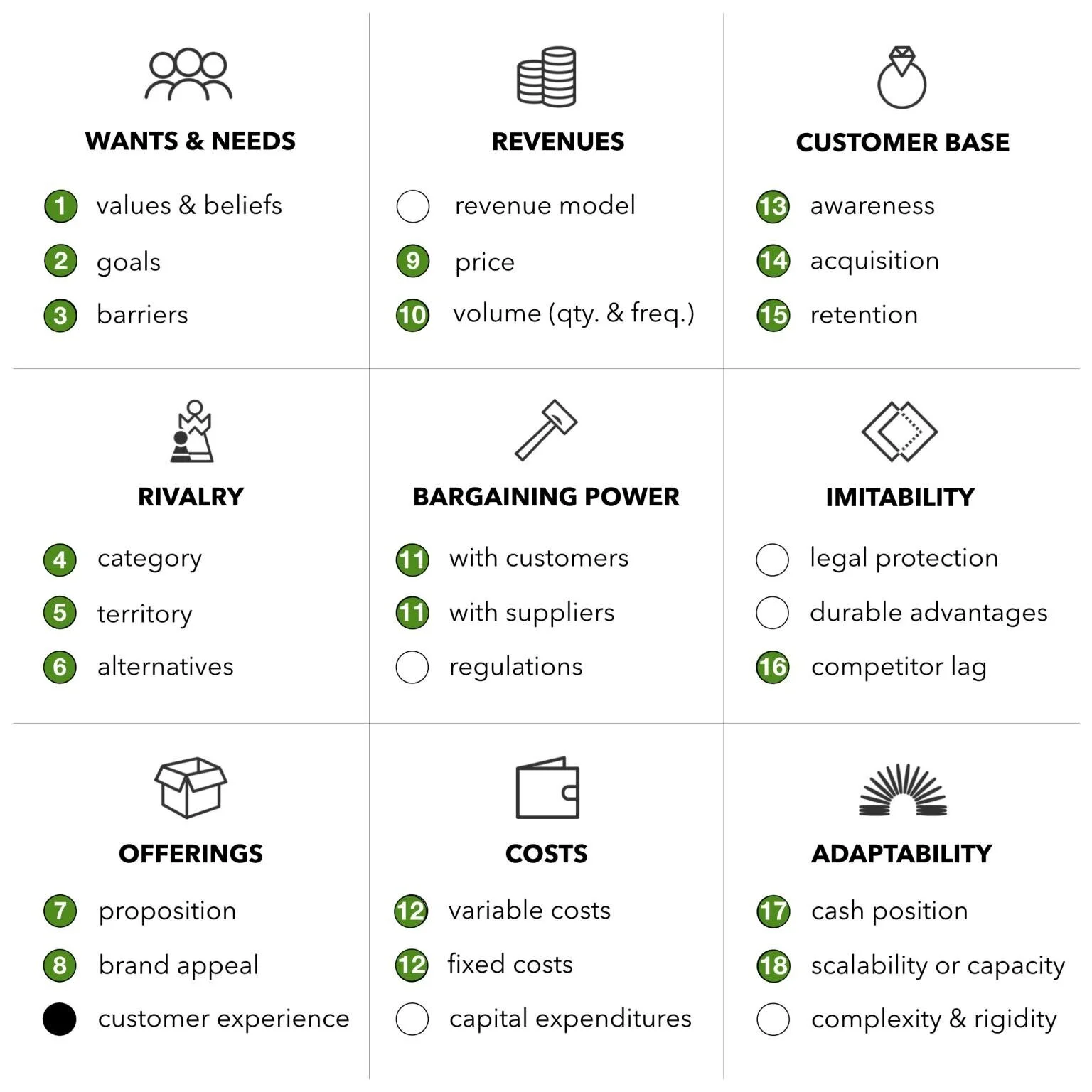
CX projects with clear objectives are more likely to succeed. Following on from Monday's post, the grid also reveals the surprising breadth of value creating objectives CX teams can pursue:
1. Better alignment with customer beliefs and values
2. Increased utility
3. Lower adoption barriers
4. Superior delivery of category basics
5. Better localization
6. Reduced choice paralysis (inc. educating the customer on how to choose)
7. Added value to the product or service
8. Stronger brand appeal
9. Increased pricing power
10. Greater purchase frequency or quantity
11. Increased social capital (customer and supplier goodwill)
12. Lower fixed and variable costs (through improved self-service, reduced complaints, etc.)
13. Higher awareness, remarkability or positive word of mouth
14. Increased conversion / acquisition
15. Reduced churn
16. Setting new standards others must follow
17. Improved working capital / cashflow
18. More efficient operations
Here's what to do:
Start by selecting specific objectives from the list above, based on your business's challenges, opportunities or strategy.
Determine how CX improvements might help you achieve them.
Choose objective-specific metrics that can demonstrate your progress (where possible).
Get to work! :)
See this post on LinkedIn