
These posts are duplicated from LinkedIn, where they’re seen by tens of thousands of people each week. They often spark lively, valuable debate and your voice would be welcome. Visit my profile to connect with me.
As a general rule, simply better beats deliberately different. And this insight should have a profound impact on the direction and focus of CX initiatives. Here’s why.
In every category of product or service there are generic sources of value that appeal to the most customers, most of the time. In online shopping for example, everyone benefits from a simple transaction, prompt reliable delivery, and easy returns.
To dominate your market, you want to out-perform rivals on these generic factors because it makes you most attractive, to the most people, in the most buying situations.
And yet, performance on these fundamental sources of value varies substantially between competitors, however much we consider them “table stakes”.
You will no doubt have experienced this in your personal life — occasionally wondering why routine, high frequency or important tasks as a customer are often so painful or clunky. I can tell you why.
Rather than aspiring to be better, most brands aspire to be different in some way. They try to cook up a USP, or get entranced by new fads, technologies or side-shows that they think will make them stand out.
This causes them to systematically ignore the generic sources of value, even though they have the greatest impact on how appealing the experience is to current and prospective customers.
To cut to the chase: if your CX program isn’t designed to maximize performance on these generic sources of value, there’s a huge opportunity that’s staring you in the face.
This topic has so far been one of the three most popular parts of The Leader’s Guide to Customer Experience e-learning course, and I’m delighted that the feedback so far has been excellent. Link is in the comments!
Ps. There’s a book on this called Simply Better by Patrick Barwise — highly recommended also. It’s one of the further reading recommendations in the course.
See this post on LinkedIn
You cannot create a customer experience that strengthens your brand without focus and consistency.
Amazon is a great example. Their ecommerce business was built on ease and reliability: simple ordering, prompt delivery, hassle free returns. Consistent reliable service.
This means there’s a lot of things they don’t do. They aren’t sexy. They aren’t emotional. You don’t feel like part of a tribe. Just easy and reliable — over and over and over again.
There’s a crucial point here. CX improvements can exist on paper, but that isn’t what matters. What matters is whether those improvements are focused enough to be noticeable, and reinforced consistently enough to build strong associations between desirable qualities and your brand.
One of the reasons CX programs often fail to deliver meaningful returns is because the improvements they make are too diffuse. They are not focussed enough for customers to even notice them, let alone strengthen the brand. They try to do too many things at once. They are all over the map.
You need to have the courage to define a crystalline experiential signature and say no to everything else – to commit to being known for just one or two things. Otherwise you’re probably just throwing money away.
There's a simple acid test. Just ask yourself “What do we want to be known for?” If you don’t know, if your colleagues don’t know, or if there’s no agreement, focus or clarity you must attack this issue as a priority.
The Leader’s Guide to Customer Experience explains this opportunity and many, many more. Link in the comments!
#customerexperience #cx
See this post on LinkedIn
One of the most powerful and practical decision-making techniques I discovered while researching Mastering Uncertainty is Suzy Welch’s idea of 10-10-10.
It's simple — you just ask yourself what you think the consequences of a particular decision (or continuation of the status quo) will be in ten minutes, ten months and ten years.
This technique can help you take a long view when making big decisions: Do I really want to be in this relationship, job, etc. if it carries on like this for the next ten years? Will this decision hurt in the next ten seconds but be great in the long-run?
It can also help you stop over-thinking small decisions that will have no impact in ten months, let alone ten years. It doesn’t really make sense to agonize over whether to have a cappuccino or a latte, for example.
10-10-10. It’s a simple but extraordinarily powerful technique, especially when you extrapolate out the impact of your decisions or behaviors to a ten year time horizon.
See this post on LinkedIn
There is a dominant assumption within the CX industry that more satisfaction means more loyalty, and that increasing loyalty is the most effective path to growth. Yet there is very little data to support these beliefs.
To quote Tim Keiningham et al. “Our research finds that changes in satisfaction (and NPS) explain a miniscule 0.4 percent of a change in share of wallet over time.”
Matt Dixon’s research in The Effortless Experience found “Virtually no statistical relationship between how a customer rates a company on a satisfaction survey and their future customer loyalty.”
Even Fred Reichheld’s research in The Ultimate Question confirmed that these beliefs are unfounded: “60 to 80 percent of customers who ultimately defect had said they were satisfied or even very satisfied the last time they participated in a survey.”
Furthermore, as Byron Sharp points out in his influential book — How Brands Grow — a loyalty first approach is not the optimum path to growth:
“In market after market, the potential gains from acquisition dwarf the potential gains from reducing defection…Growth is due to extraordinary acquisition. Contraction is due to dismal acquisition.”
What does all this mean? If your CX programme is promising commercial returns to the business through improving satisfaction and loyalty, you might be facing an uphill struggle.
If you’d prefer to take an evidence based approach to running CX programs that deliver real world results, The Leader’s Guide to Customer Experience is here to help. Link in the comments!
#customerexperience #cx
See this post on LinkedIn
TL;DR: "A breath of fresh air... If you're a practitioner, if you're a designer, if you're any way interested in what you can do to improve your CX, and have programmes that deliver commercial results then I highly recommend this course."
So says the editor of MyCustomer.com and who am I argue?
Link to the course in the comments.
#customerexperience #cx
See this post on LinkedIn
Transformation — whether in business or in our personal lives — is an unhelpful ambition. Here are four reasons why:
1. The bigger the change the greater the resistance.
Resisting change is natural for most people in most circumstances. There is no bigger form of change than transformation, so it provokes the greatest opposition. The great strategist B. H. Liddell Hart skewered this problem beautifully when he wrote that “The direct assault of new ideas provokes a stubborn resistance, thus intensifying the difficulty of producing a change.”
2. It is unrealistic.
Yes people do transform and so do companies. But we only hear about these transformations because they make the news, and they only make the news because they are outlier events. In reality most attempts to transform fail. We're better off pursuing less grandiose strategies that have a higher chance of success.
3. It’s probably unnecessary.
Let’s be honest: do we need to transform or do we just need to improve? Probably the latter, and attempting that instead alleviates a lot of stress and pressure, reduces complexity and generally lends itself to pragmatism.
4. It’s unnatural.
Look around you at how most change happens. Two words: evolution and compounding. Small, consistent changes over long periods of time are where exceptional performance and growth come from, not seismic changes. Becoming an overnight success usually takes a decade of consistent effort. In reality getting 1% better every day is the path to greatness, not attempting to make a 1000% change in one transformative swoop.
Don't aspire to transform, aspire to continually improve. You'll achieve far more this way.
#strategy #transformation
See this post on LinkedIn
I'm excited to share that The Leader’s Guide to Customer Experience e-learning course is now live! Here’s what you can learn in under two hours:
What success looks like when it comes to customer experience projects.
The six most common causes of CX project failure.
How every company creates value for its customers.
The single most important question you must ask before embarking on any CX initiative.
How to pinpoint the force multipliers that have the biggest impact on customers.
Why simply better beats deliberately different.
Why satisfaction and NPS scores are ineffective measures of CX success and what to measure instead.
The real relationship between satisfaction and loyalty.
Four reasons why acquiring new customers is a better path to growth than increasing loyalty.
Why long-standing, loyal customers do the least promoting for your brand.
How to align your CX program to the commercial ambitions of the business.
Why the idea of an ROI for CX programs is often the problem itself, not the goal.
How thinking in terms of “affordable loss” unlocks your ability to innovate.
How to align your CX and brand strategy through creating an experiential signature.
Common barriers to execution that prevent real-world improvements.
How to structure CX programs to deliver results fast.
Techniques for prioritizing opportunities for maximum impact.
The vital but often overlooked role of expectation management.
All of the content is evidence-based and tested in practice. If you want to achieve that elusive win-win-win: more value for customers, a stronger brand, and real-world business results, look no further.
Here is the link : https://lnkd.in/gsmrCeKU
#customerexperience #cx
See this post on LinkedIn
If someone calls you a perfectionist don’t take it as a compliment.
The pursuit of perfection is debilitating. It’s not motivated by a zeal for quality or absolute performance. It really comes from a place of fear of not being good enough, and anxiety about how we or our work will be perceived.
Perfectionism keeps us analyzing, tweaking and polishing and provides a conveyor belt of excuses for why we can’t ever finish or launch things. And because it is purely outcome driven, achieving it (if such a thing is ever possible) provides only momentary relief before the horizon recedes again.
A more valuable pursuit than perfection is mastery.
Unlike perfectionism, mastery is a process not an outcome which brings meaning to every day regardless of our performance.
Mastery is also driven by a deep desire to keep improving. It keeps us coachable, humble and open to new ideas. It encourages us to launch, learn and grow.
Aspire to mastery not perfection, and you’ll accomplish far more (and enjoy it more too!)
See this post on LinkedIn
I’m skeptical about the whole concept of “employee experience” but I’m sincerely open to changing my mind.
To be clear, I definitely think that how employees (or freelancers for that matter!) are treated and what their day-to-day working life is like is hugely important to their wellbeing, productivity, creativity, happiness etc. That’s not in doubt, and we try our best to make Methodical a great place to work.
I just hope some of you can help me by answering some questions I have:
1. What is the difference between managing the employee experience and existing people management and leadership skills?
2. What can an employee experience team do that a HR team can’t?
3. How can we attempt to directly manage something that is clearly emergent?
In other words isn’t an employee’s experience mostly going to depend on whether their boss is a PITA, whether they get interesting engaging projects to work on, whether they are a good cultural fit, whether they like their colleagues, how much they get paid, whether they can progress and grow, office politics, and all the other stuff we’ve known about for forever?
4. What is an employee experience expert going to do in practical terms when confronted with these realities? Take ownership of all of them?
I’m all ears. I don’t know anything about it. Zero qualifications to have an opinion. Here to learn.
See this post on LinkedIn
Why do we attach status to being busy and not to being productive?
Busy is slicing your time into vapour with back to back meetings. Productive is large chunks of uninterrupted time.
Busy is filling your day from dusk ‘til dawn. Productive is having downtime so you perform at your best.
Busy is doing a million different things at once. Productive is tackling your priorities in order.
Busy is saying yes to everything and being overwhelmed. Productive is saying no to anything that doesn’t matter.
Busy is a cacophony. Productive is a quiet hum.
Busy is telling everyone how busy you are. Productive is letting the output speak for itself.
Busy sucks. Productive is beautiful.
I think it’s time we stopped celebrating being busy, and started celebrating being productive instead.
See this post on LinkedIn
Many people believe that satisfaction is the ultimate customer experience metric. It is not. In fact, it’s typically not an appropriate customer experience metric at all.
Think about it.
What is satisfaction?
It’s a rating of how much the value a customer thinks they got, compared to the value they expected to get. In other words, satisfaction is a measure of perceived value.
What affects that perception of value?
Pretty much anything: brand image, pricing, the range of available alternatives, features, quality, adoption barriers, ease of use, reliability, customer care, yelp reviews, advertising and awareness, the sales experience, et. cetera. Change any one of them and satisfaction will likely change.
Next question: If you work in customer experience, which of those factors above do you control or can you directly impact? A minority of them at best. You likely don’t control brand, marketing, pricing, ad copy, product design, what your competitors do, etc.
Next next question: Does it make sense to have your performance judged on a metric that is almost completely out of your control, where cause and effect cannot be easily demonstrated, and where there are manifold, often unknowable factors that might move scores up or down? I don't think so.
There you have it. Satisfaction is typically not an appropriate metric for judging the success of CX initiatives. Worst of all? It makes demonstrating value to business stakeholders all but impossible — something that should be on everyone’s list for 2023 as the belts tighten…
The leader’s guide to customer experience e-learning course — which explains all this sort of stuff and what to do about it — is coming next Monday.
See this post on LinkedIn
Fear of failure has held me back for most of my adult life, and it’s only in the last few years that a series of realizations allowed me to tame it.
The first was simply this: if we do not try, we have failed by default.
I used to think that as long as I didn’t try something I couldn’t fail at it. Many people share this sentiment, but it’s not really true.
In fact, all this line of thinking does is keep us in our hum-drum routines, stop us from exploring hobbies we might fall in love with, or pursuing business ideas that excite us.
Instead we must recognize the truth of the matter: in order to succeed at anything we have to try. And if we try but fail we will learn something from it.
What happens if we do not try? Not only is success impossible, we dont learn anything either — a double negative.
The only prudent course of action then — if we aspire to fulfill our potential and enjoy all of what life might have to offer — is to try things out that capture our interest.
You’ll win or you’ll learn, but either way you benefit.
See this post on LinkedIn
Many CX practitioners remark that they feel marginalized, can’t get traction, can petition for change but can’t enact it. That leaders don’t see the value in what they’re doing, or it can't be proven commercially.
If this sounds familiar to you, and you would like to have a greater impact with both your customers and you business, stay tuned.
The successor to The Ten Principles Behind Great Customer Experiences is coming soon — The Leader’s Guide to Customer Experience.
Oh and it’s not a book. It’s an e-learning course.
#customerexperience #cx
See this post on LinkedIn

I’m excited / relieved to have got the first physical copies of my third book — Mastering Uncertainty: How great founders, entrepreneurs and business leaders thrive in an unpredictable world — which is out at the end of March.
I couldn’t be happier with how this book has turned out. It was a dream experience to work with and learn so much from my co-author Csaba Konkoly. And the amazing teams at Penguin Random House and Matt Holt books have brought a level of polish and quality to the finished product that we can all be very proud of.
I can’t wait to share it with you in a couple of months or so!
See this post on LinkedIn
When it comes to big, ambitious projects — writing a book, renovating a house, learning Rachmaninov’s Paganini variations, (insert your ambition here) — a common cause of failure is working too hard.
These kinds of projects require consistent effort over the long haul — often for years — while overcoming unforeseen setbacks and obstacles.
This means the key to success is figuring out a work-rate and routine that is easy enough to stick to every day without tiring you out, but significant enough that you can see progress over days, weeks and months.
You want gentle, unflustered momentum that you can sustain indefinitely.
For example, I know that I can write from 7:30 am to noon, day in, day out, 365 days a year if necessary. I also know that if I reach a thousand good words in a day I should stop. Doing more creates a kind of intellectual hangover the next day that means I am less productive.
In contrast, what often causes people to give up is binge working and sprinting. They go all out, get tired and then when the setbacks come they quit in exhausted frustration.
It may sound counterintuitive then, but if you’re struggling to finish a big project, make consistent progress, or have given up entirely you were probably working too hard.
Instead, make it your goal to identify a cadence and routine that is comfortable every day, then stick to it. You’ll be amazed what you can accomplish in ten years at a steady, sustainable pace.
See this post on LinkedIn
Most competitive activities combine attacking and defending. The goalkeeper in soccer isn’t there to score. They’re there to stop others scoring against you. They help you win by not losing.
The same is true in business. We have attacking activities intended to help the organization grow — advertising, sales, product development, etc. — and defending activities that prevent the organization from losing or otherwise coming to harm. Legal compliance is important unless you want to incur fines, or compromise your reputation, for example. We also need insurance if we run a business. But neither are part of a growth strategy.
So far so obvious, except for two things.
First, it’s not always clear which kind of activity we’re doing. I’d argue that the way most people think of customer experience for example — a focus on loyalty and retention — is almost entirely defensive. Yet at the same time it’s often sold as a path to growth.
Second, while you can’t promise a ROI for defensive activities, that doesn’t make them unimportant. What’s the ROI of insurance, for example? Ideally you buy it and never use it. Promising a return in such a circumstance doesn’t make sense.
Which brings me back to CX programs again. If your approach is entirely defensive, promising a return on investment is the easiest way to ensure your program is eventually terminated, because it won’t deliver one.
It would be better to sell it as a form of insurance against customer resentment, brand damage and changing competitive conditions, which in reality is all most loyalty-based programs are capable of accomplishing.
See this post on LinkedIn
If you’re a consultant, freelancer, or subject matter expert here are ten questions you should ask prospects or clients on your first call to discuss a project:
1. What is your current situation?
2. What is the future outcome you’re trying to get to?
3. What challenges or obstacles stand in your way of achieving that outcome?
4. What impact are those challenges having?
5. What will happen if you don’t achieve the outcome or address those challenges?
6. Why is now the right time for this project?
7. Who needs to support this initiative internally for it to succeed and do they?
8. Fast forward a year and the project has been a great success — how are things different?
9. How are you personally feeling about the project?
10. What matters most to you about who you partner with?
The better you know your customers’ needs the more obvious it is how you can add value and more likely you are to win the work. Asking the right questions is the key to the kingdom!
See this post on LinkedIn
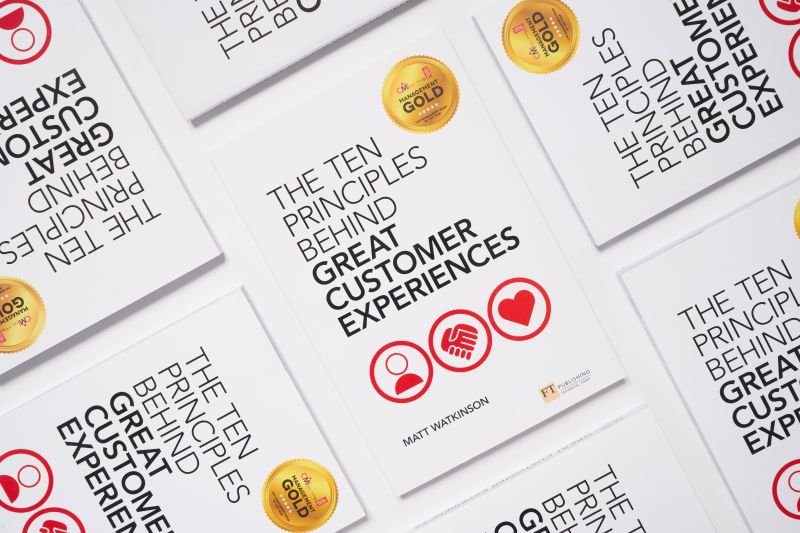
It’s ten years this month since my first book — The Ten Principles Behind Great Customer Experiences — was published.
As a first go it couldn’t really have gone any better (once I overcame the twelve rejections it took to get it published.)
It won Management Book of the Year. Rory Sutherland mentioned it in his TED talk. Some organizations ordered a thousand copies at a time. I suddenly found myself with a speaking career. And I was able to use it as a calling card to build a growing consulting practice.
I’m also delighted with how well the principles themselves have held up. Sure, there are things I’d change with ten years more experience, but overall the ten basic guidelines work remarkably well as a primer on the topic which is why it's still selling today.
I'm overwhelmingly grateful to everyone who has bought it, shared it, written about it, invited me to speak about it, or have used the ideas in practice. If that's you, know that you made my dream come true. Thank you.
X
See this post on LinkedIn
Luckily for me work is now done for the year. I'm very grateful for all the dialogue, connections and friendships this platform has brought me in 2022, and looking forward to more of the same next year. I hope you all have a wonderful break over the holidays and new year.
I worked out last year that as long as I do an hour a day on the rowing machine I can eat and drink what I like and still just about fit in my trousers. Let's see how that goes...
See you in 2023 x
See this post on LinkedIn
Conventional wisdom tells us to focus on clear, achievable and measurable goals. Unfortunately though, with everything that matters in life, outcomes cannot be guaranteed.
You might ask your crush on a date but they could say yes or no.
You might see your dream job advertised but there’s no way of knowing if you'll get it.
You might want to learn the trumpet but have no idea if you'll be good at it.
You might have a cool idea for a new feature but can’t know in advance if customers will love it.
Uncertainty is unavoidable. If we limit our scope to activities where the result is knowable in advance or obviously achievable, we’re never going to develop, grow, or fulfill our potential.
Fortunately there’s a simple solution. When we’re presented with an interesting idea or opportunity, rather than focusing on how certain the outcome is, we should simply ask “What’s my downside?” And if it’s acceptable, go right ahead.
This simple re-framing is immensely powerful. Once you realize how little downside you face in most situations, you'll be willing to give more things a go, and increase your scope of opportunity exponentially.
See this post on LinkedIn